LIBERAL DEMOCRACY
The Prime Etonian
Portrait
Boris Johnson plays the clown but he has turned himself into one of Britain’s most dominant prime ministers. How has he done it? Andrew Adonis tells the tale of one school and a literal class act
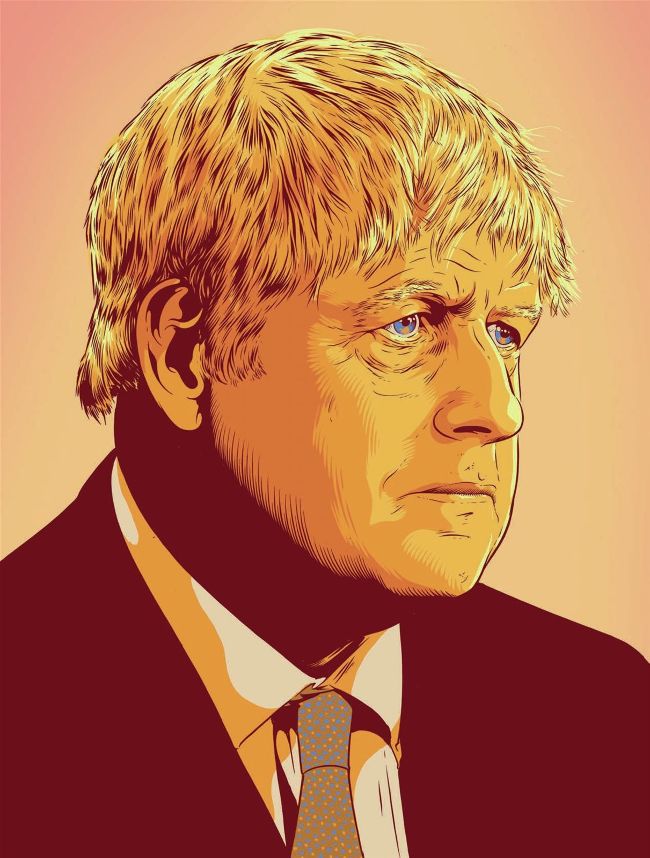
ILLUSTRATION BY TIM MCDONAGH
Never underestimate the capacity of Boris Johnson to win from a tight corner, and all his corners are tight. In his 13 years at the top of politics, since he became mayor of London in 2008, he has despatched all his rivals in dramas whose common theme is the extraordinary self-belief, exhibitionism and sheer entitlement of the Prime Etonian.
Prime ministers Cameron and May, opposition leaders Corbyn, Swinson and Farage, Mayor Livingstone, a litany of chancellors, foreign secretaries, ministers, MPs and permanent secretaries—all lie side by side in the Westminster graveyard, joined recently by pre-eminent adviser Dominic Cummings. Keir Starmer, an initially promising Labour leader, is on the danger list. No duty or person instils obligation—not the Queen, brazenly manipulated en route to the 2019 election, not the brother Johnson drove out of the Commons before installing in the Lords, and not the wife he swapped for a younger one, like Catherine of Aragon for Anne Boleyn, while occupying the supreme office.
In terms of accumulated political power, post-vaccine Boris rivals post-Falklands Thatcher and pre-Iraq Blair. So it is time to take the Johnson phenomenon seriously and explain it. Here goes, from one who knows him fairly well.
Boris isn’t a conventional political project, but a personal project for supremacy and celebrity. Most leaders at least claim to be servants of ideas and causes, whereas he grabs contrasting ideas and causes as if choosing vegetables for a ratatouille: “I haven’t got any political opinions,” he told a friend when seeking to become an MP. All that matters is that the colours are bright, and that the chef is glorified.
Even Brexit, perhaps his one enduring legacy, turned on naked self-advancement. My last one-to-one meeting with him, on 3rd February 2016, notionally to discuss Crossrail with London’s still-mayor, soon turned into an agonised discussion of political options. It was moments after he had left the House of Commons chamber, where he had offered a fence-sitting response to Cameron’s statement of his EU renegotiation terms and the setting of the referendum date for 23rd June. Pacing around his office, hand ruffling hair, he told me that he was “buggered” if he knew which side to take.
“Isn’t the right thing to say that it’s high time we started to lead in Europe, as your hero Churchill would have led?” I said. “Yes, well no,” he stammered. “That means Cameron leading, and that won’t work.” Wouldn’t work for himself, I think he meant, rather than for the country. He also trialled on me a populist riff on “shaking these grand corporate and diplomatic panjandrums out of their complacency”—a dress rehearsal for the “fuck business” of 2018 when the CBI pressed to stay in Margaret Thatcher’s EU single market.
Trump is often cited as a populist parallel, but Boris pulled off his coup in a parliamentary system where it is virtually impossible to win from the outside. He triumphed because he is modern England’s supreme insider and seeming outsider at the same time. Electorally, he was the first politician to carry a UK-wide referendum against a prime minister, reaching downtrodden parts no other modern Conservative politician has reached. Bolsover, Bassetlaw and Blyth Valley are all Boris blue, as now is Hartlepool, a rare and remarkable government by-election gain this May, won by running as an insurgent in power. But socially and psychologically, he imbibed and exudes Etonian elitism to an extreme degree, emerging from the school in Thatcher’s decade of widening inequality, part of the vanguard of a new generation of Etonians asserting a right to rule and dominate. An extrovert by nature, he built himself a disarmingly popular, seemingly apolitical one-man band on these Etonian foundations, a sort of Bertie Wooster meets Henry VIII, bumbling and disarming yet cunning, ruthless and lethal.
Back in the late 1970s, when Boris started at the school, many thought there would never be another Etonian in No 10. Thatcher’s meritocratic Tories were thought to be too canny for that, learning from Alec Douglas-Home’s defeat in 1964 by Harold Wilson, a lowermiddle-class Yorkshire grammar school boy.
Douglas-Home made a good joke in reply to Wilson’s jibe about being a 14th Earl—“I suppose when you think about it Mr Wilson is the 14th Mr Wilson”—but he still lost, and was rapidly replaced by a Tory middle-class grammar school boy, Ted Heath, who in turn was succeeded by the most