Life, books and arts
The three worst words
Inside the Imperial War Museum’s battle to appeal to a divided nation
ANTONIA CUNDY
© IWM
For many British people, the silver underbelly of a Supermarine Spitfire is lodged in their childhood memories: the plane climbs upwards, its yellow-tipped wings tilted towards the heavens. But this particular Spitfire is frozen in flight, its nose pointing to the ceiling of London’s Imperial War Museum, through which 100,000 children—brought by schools, parents and grandparents—troop each year.
The IWM was created in 1917 to record the civilian and military experiences of the stillraging First World War. Martin Conway, its first director, said he wanted the museum to “make a direct appeal to the millions of individuals who have taken part in the war or in war-work of any kind.” “When they visit the museum in years to come,” he wrote, “they should be able by its aid to revive the memory of their work for the war, and, pointing to some exhibit, to say, ‘This thing I did.’”
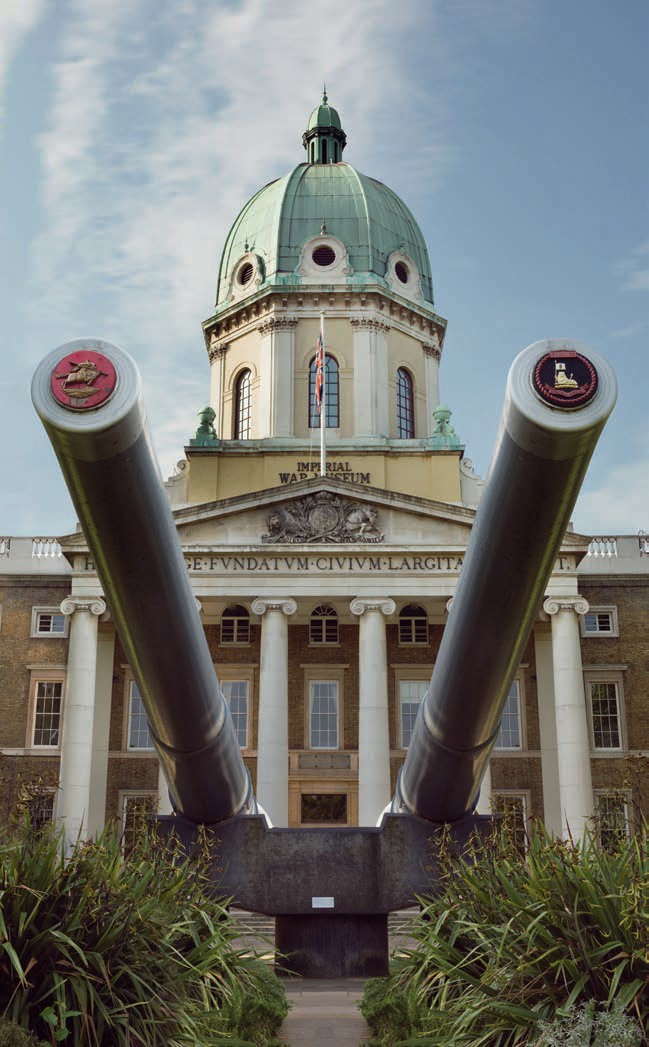
After brief stints in Crystal Palace and South Kensington, in 1936 the IWM was housed where it remains today: under the copper-clad dome of the old Bethlem Royal Hospital in south London. For decades, two 100-tonne naval guns have greeted visitors outside its front steps. But while the museum has stood still, a generation has moved on. As those with direct experience of the world wars pass away, the IWM no longer has Conway’s original justification. Although the museum’s atrium—“the biggest boy’s bedroom in Britain,” in the words of historian Kasia Tomasiewicz—still draws school trips, few return as adults. And while its remit now extends into the present day and beyond conflicts that British forces have been directly involved in— instead including wars relevant to the UK public, media and parliamentary debate—few think of the IWM as a place to learn about modern warfare.
The struggle to modernise and attract new audiences is of course felt by other museums, many of which are also grappling with conflicting views of history and identity centred around race and the legacy of empire. But the culture wars are inevitably and especially testing for an institution rooted, literally, in imperial war. In a diverse society, what narratives does a national war museum tell? And when these debates divide baby boomers from millennials, left from right, how does a museum of conflict stay relevant to all?
““If you approach a young person in the street—and when I say young, I mean probably up to the age of 40—and say, ‘when was the last time you went to the Imperial War Museum?’ the majority will say it was on a school trip,” says Eleanor Head, who runs the IWM Institute, the museum’s “innovation hub” launched at the end of 2020.