TOMORROW’S ECONOMY
Money trouble
The global financial system is addicted to quantitative easing, and going cold turkey could be lethal. The only safe way to quit is to change the system itself
ANN PETTIFOR
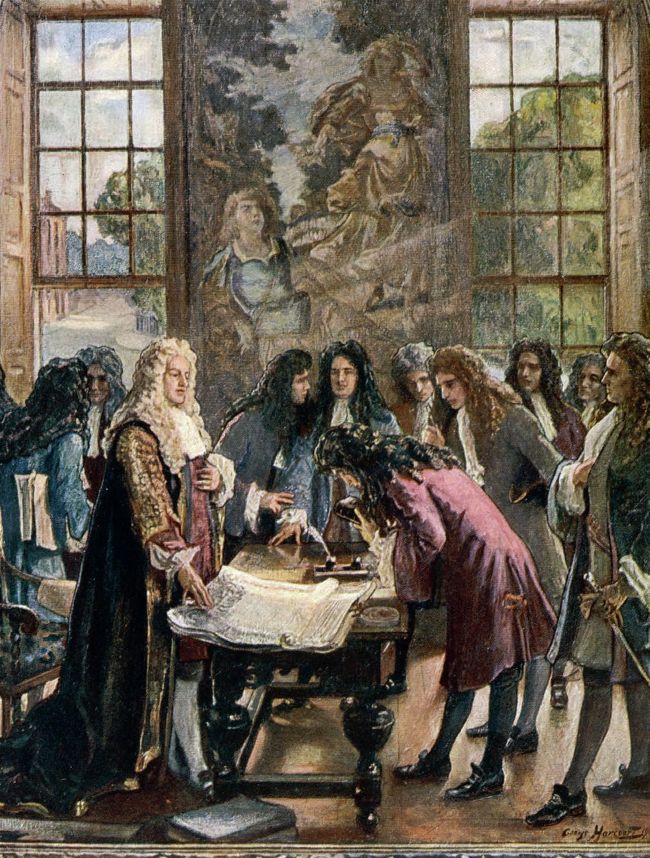
“Guardian of the nation’s finances”: the founding of the Bank of England in 1694
© CHRONICLE / ALAMY STOCK PHOTO
The world economy is a mess. The system, notionally governed by the invisible hand of the market, is no longer governed in any meaningful way: private excess puffs up bubbles that government indulgence ensures can never burst. We seem condemned to volatile commodity prices, wild capital flows, worsening imbalances in trade, taxation and income, and—before long—the next sovereign debt crisis. And then there’s inequality. During lockdown, the total wealth of billionaires rose by $5 trillion to $13 trillion in 12 months, the most dramatic surge ever registered on the annual Forbes billionaire list.
Where do such riches come from? Compared to before the pandemic, there’s less real economic activity: we are collectively poorer. And yet within a year of the great panic of March 2020, many asset prices were surging. Wall Street and the City of London are again awash with liquidity—and in a speculative mood. One vogue is for something called SPACs, or “special purpose acquisition companies.” That sounds so vague as to bring to mind the South Sea Bubble companies of 1720, whose pitch is remembered as “carrying on an undertaking of great advantage but nobody to know what it is.”
How is this mismatch between financial markets and underlying reality possible? Because just like in the aftermath of the Great Recession, the civil servants in our central banks spotted the dreadful potential of unchecked panic, and rode to the rescue of private speculators by flushing the system with made-up money through a process we’ve come to know as quantitative easing.
Commentators on both the right and the left are increasingly fixated on the role of QE. In a way, that’s understandable. The policy—deployed on and off ever since the financial crash— has been pursued to an extraordinary degree in the face of Covid-19. By this June, the US Federal Reserve’s balance sheet had doubled in size since the pandemic began, and has now swelled by 800 per cent since 2007.
Orthodox voices, such as American broker Peter Schiff and US economist Larry Summers, fret about inflation and debauching the currency. Meanwhile, radical thinkers such as Guy Standing rail at QE-induced assetprice rises enriching the “have-yachts” over the many have-nots on precarious, stagnant wages. Central banks stand charged with morphing from guarantors of stability to underwriters of inequality.
All sides worry about the danger of getting hooked, including some of the central bankers themselves. At his swansong Monetary Policy Committee in June, the Bank of England’s outgoing chief economist, Andy Haldane, pleaded for the Bank to start rolling back the QE programme, but was outvoted by colleagues who feared the consequences. After successive QE bailouts—for the 2008 banking meltdown, the Eurozone crisis, the Brexit vote and now Covid—we have learned that QE is easier to start than stop. After the US Federal Reserve tried to “taper” its way out of dependency in 2013, it soon decided that the market “tantrum” provoked was more dangerous than yielding to the addiction.