DESIGNING SILO
THE EMMY-WINNING DESIGN TEAM BEHIND – SET DECORATOR AMANDA BERNSTEIN AND PRODUCTION DESIGNER GAVIN BOCQUET – TALK SFX THROUGH CREATING THE SHOW’S UNDERGROUND WORLD OF SEASON ONE
WORDS: JACK SHEPHERD AND DARREN SCOTT
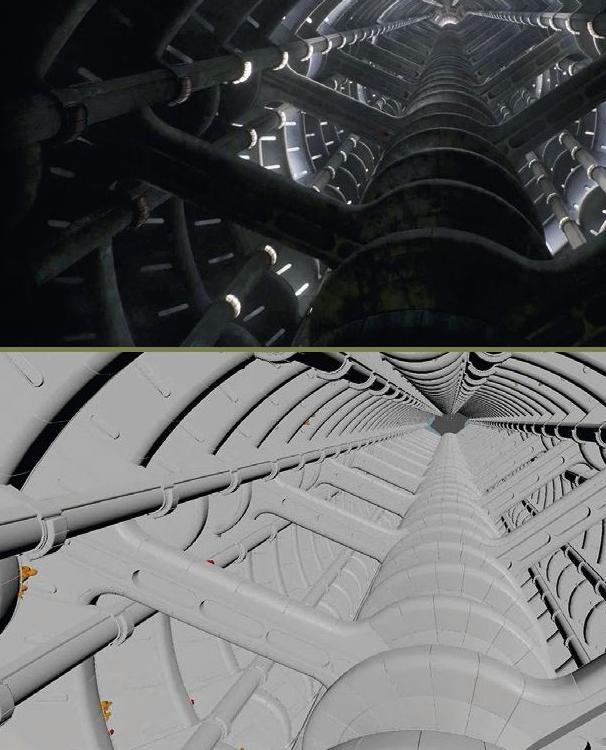
Previs images of the main shaft, shaded and plain.
CONCRETE JUNGLE
Gavin Bocquet:
When you start, there’s always that element of, “How do we achieve this?” It’s not like you can go and shoot this on the streets of London. It doesn’t exist. With this, I hadn’t read the novels, but I knew roughly that we were going to need to create this underground silo. That was going to be a challenge because, although the budget was good, there’s never enough money, time or stage space to do what you have to do.
So the first thing was to conceptualise what this world looks like. We had six or eight weeks of concept work, doing research, and showing it to [showrunner] Graham Yost and [director] Morten Tyldum. The general feeling was that the architectural style should reference Eastern socialist architecture of the ’40s and ’50s – concrete, very austere, very functional, very nondescript. Using concrete would give us a lot of room to manoeuvre with finishes and textures, and would allow us to show people where they were in the silo – slightly better conditions up top, and damp and crumbling down below. In some of the early concepts, we introduced quite a lot of supporting metalwork, but they made it look too “sci-fi”.
Amanda Bernstein:
I wrote a blurb about how the higher up the silo you are, the brighter the colours and the more beautiful it is. The less recycled the things are. Anything made of glass at the top of the silo is always flawed and there are always bubbles in the glass. It’s not quite clear. The further you go down, the glass is grey or dirty brown, because everything was recycled. Linens at the top could be natural, off-white, and by the time you get down to Juliette, her linen quilt is a dark brown. It had been mended, it had gone through the whole recycling system several times. You have to make rules for yourself that no one else has to know about.