Keep the wolf from the door
Joseph Curtin describes a quick and simple method for violinists to eliminate a wolf tone on their instrument, along with the science behind it.
Lutherie
Points of interest to violin and bow makers
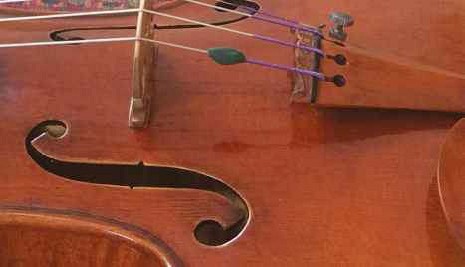
How a piece of modelling clay can be attached to a string’s afterlength to eliminate a wolf note
Pluck the afterlength of your violin’s G string and you will hear a note about two octaves above the open Destring. If the instrument has a wolf note, it is typically in the octave below that, between C and C sharp. Detuning the afterlength until it matches the frequency of the wolf is a powerful way to get rid of it.
This detuning is easily accomplished with a bit of modelling clay. Roll some into a ball the size of a pea, wrap it around the string halfway between the bridge and the tailpiece, and then spread it out a bit (see photo). The more clay you use, the bigger the drop in frequency, so start with very little.