Reviews
Your monthly critical round-up of performances, recordings and publications
CONCERTS
New York
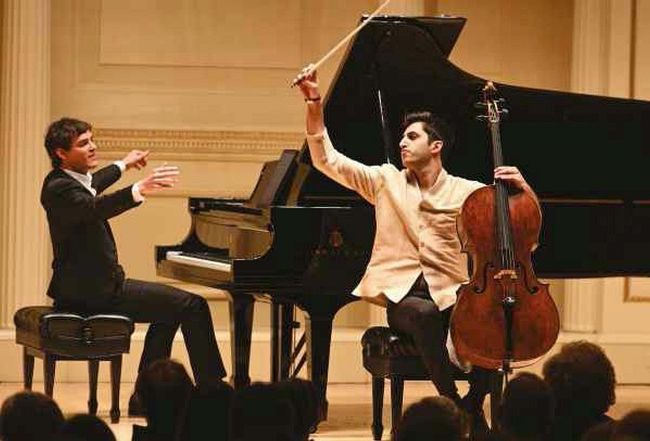
Kian Soltani (right) and Aaron Pilsan delight the audience
KIAN SOLTANI (CELLO)
AARON PILSAN (PIANO)
WELL RECITAL HALL 2 MAY 2019
It’s not often that an encore almost steals the show. But after a juicy programme at Weill Recital Hall, Kian Soltani and Aaron Pilsan unleashed New York Honk (1987) by the Swiss cellist and composer homas Demenga. In slightly over two minutes, Demenga combines a cartoonish, rapid-ire piano line, over which the cello replicates an array of honking cars, squealing buses, and impatient delivery trucks. With hairpin accuracy and timing, Soltani and Pilsan delighted the sold-out audience.
Just prior, the duo had completed Shostakovich’s volatile Cello Sonata in D minor op.40, with the cellist relying on memory, and the pianist with an increasingly ubiquitous iPad. From the irst movement’s ghostly closing pizzicatos, to the vertiginous waltz and achingly sorrowful slow movement, to the inal explosive detonations, Soltani’s tone conquered all (he plays a Milanese Grancino instrument from 1680). At the end, the audience shouts were a natural reaction to the relentless intensity.
For the inale, Piazzolla’s Le grand tango (played by Gautier Capuçon and Yuja Wang scarcely a week earlier, reviewed July 2019) conjured up the dim recesses of a Buenos Aires nightclub. Soltani was especially efective in the blistering glissandos and deployed bow pressure to create a gravelly haze.
To open the evening, Schumann’s Adagio and Allegro op.70 was adroitly phrased, with the latter portion festive but not out of control. And even though Beethoven’s Cello Sonata in A major op.69 rewards struggle, neither artist showed any signs of strain. Whether thumping pizzicatos, surprising dynamic shifts, or a whif of impishness, the chain of surprises yielded maximum drama.
BRUCE HODGES
PETE CHECCHIA
To browse through more than a decade of The Strad ’s recording reviews, visit www.thestrad.com/reviews
ESCHER QUARTET
ALICE TULLY HALL 7 MAY 2019
Mozart’s third ‘Prussian’ Quartet no.23 in F major K590 ofered a lively start to the Escher Quartet’s programme at Alice Tully Hall, with thoughtful colour changes that mirrored the harmonic shifts. Although the overall character of the Allegro moderato was good, the feel was a little too fast – almost tripping out of control in moments (the movement is only marked moderato after all). he third movement showed of a beautiful partnership between the two violins, and sparkling spiccato in the inner voices. he inal Allegro boasted elegant playing that never sounded thin, and impressive clarity in the softest dynamics.
The Escher took one of Charles Ives’s most dense and complex pieces of music (String Quartet no.2) and gave a comprehensible, accessible and absolutely compelling performance. he musicians’ sheer commitment to the work was memorable. he irst violin cadenzas in the Arguments movement were utterly lovely – elegant but not sappy – and the movement was brilliantly played overall. he opening to the inal movement was gorgeous and the Eschers again perfectly captured the humanity of the music. But after such a dense work, a little more ritardando to prepare the end would be appropriate.
Beethoven’s op.131 followed the interval with a poignant opening and ethereal transition to the second movement. he playful tempo changes gave the molto vivace a quirky and light-hearted feel. he violin duo variation in the Andante was very special; their colours and timing created a beautiful sense of line and the movement highlighted the quartet’s pristine ensemble – their approaches to vibrato, bow use, sound, and phrase direction were all very well matched. he Quartet demonstrated committed, sincere playing throughout, with a passionate but sophisticated interpretation of each work.
LEAH HOLLINGSWORTH
CHO-LIANG LIN (VIOLIN)
JON KIMURA PARKER (PIANO)
ROSE STUDIO AT LINCOLN CENTER 9 MAY 2019
In an evening of 20th- and 21st-century works by American composers, under the auspices of the Chamber Music Society of Lincoln Center, Cho- Liang Lin (above right) and Jon Kimura Parker brought talent and imagination to a programme titled ‘he Art of the Recital’ (a parallel recording of the menu is in the works).
Broadcast live online from the intimate environment of the Rose Studio, the duo began with John Harbison’s Sonata no.1 for Violin and Piano (2011), starting with rough and forceful double stops. he ive movements range from a riotous rondo that charges like a bull, to the inal ‘Poscritto: Misterioso’ that ends on a quietly chaste note.
Steven Stucky’s Violin Sonata (2013) opens with an ascending melody and short bow strokes – just shy of spiccato – leading to a moody central movement. he ticklish inale, with Parker easily handling the piano barrages, also showed Lin’s ability to navigate the thorniest thickets.
For the inale, Paul Schoenield’s Sonata for violin and piano (2008–9) made an entertaining choice. he irst movement is packed with references to Beethoven, Liszt, Schoenberg, Webern, and American popular songs, which sped by in a dizzying blur. Two middle sections are calmer, even gently nostalgic, before the inal ‘Freilach’ (Yiddish for ‘happy’) muscles in with klezmer run amok.
In between came Bernstein’s Canon for Aaron (1970), a valentine to Copland, and Lukas Foss’s ‘Composer’s Holiday’ from hree American Pieces (1944) – with Lin channelling his country iddler side in the latter. he Larghetto from Dvořák’s Sonatina op.100 made a touching encore.
BRUCE HODGES
QUATUOR DANEL
WASHINGTON IRVING HIGH SCHOOL 11 MAY 2019
Founded in Brussels in 1991, Quatuor Danel displayed outstanding tonal elegance and luency of phrasing in a programme of ‘Quartets nos.6’ by Beethoven and two Russians – Shostakovich and the Polish-born Mieczysław Weinberg – presented by the People’s Symphony Concerts. he opener, Beethoven’s Quartet in B lat major op.18 no.6, had a leetness and nuanced attention to balance and dynamics that clariied the textures pleasingly. When the second subject of the opening Allegro con brio was heard, it was only slightly eased in tempo and was entirely without sentimentality or underlining. he exposition repeat was omitted, perhaps due to the length of the rest of the programme. ‘La Malinconia’ was beautifully proportioned, and well-judged tempo relationships were a particular virtue throughout.
Shostakovich’s Sixth Quartet was written in August 1956 and intended by the composer to mark his 50th birthday. he third of its four movements, a passacaglia introduced by the cello, is more serious in mien than the other three, which explore the usual contrasts between faux-naive cheerfulness and occasional melancholy. he Danel players’ 2005 recording of all 15 quartets is currently available on Alpha, and their performance was a luent testament to long experience and stylistic command.
They have also recorded, with equal success for CPO, all 17 quartets of Weinberg, Shostakovich’s younger contemporary and close friend. In fact, in 2007 they played the irst performance of this 1946 score, which remained unpublished until 1979. It proved a massive work whose six movements and quasi-orchestral textures clearly resemble a late Beethoven quartet. Pizzicatos were deftly threaded in and out of strongly rhythmic and dense textures, as was a falling 4th and rising arpeggio motto theme.