Social harmony
Violinist Leonidas Kavakos this year presented his eighth Musical Horizons Conservatory masterclass series. Toby Deller attended the three-day event in Athens, during which Kavakos proved himself to be not only an intelligent and dedicated teacher, but also an advocate of social cohesion and personal responsibility through music
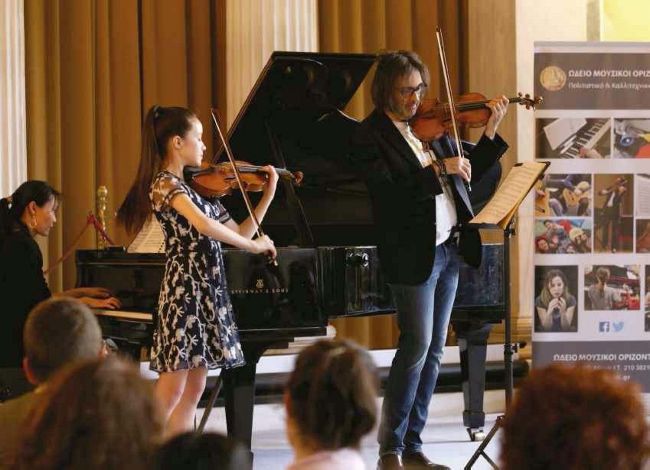
Kavakos works on Bruch’s First Concerto with 13-year-old US violinist Anais Feller at his 2019 Masterclass in Athens
The audience may have assembled in the neo-classical building that is the Academy of Athens, but it is not to listen to members of this national research institution. We are here instead to find out what Leonidas Kavakos has to say as he hosts his eighth annual masterclass. The three-day event, organised in his home city by the Musical Horizons Conservatory, features violinists and the odd chamber group, chosen by Kavakos personally, with pianists Emi Munakata and Ai Motohashi on duty throughout.
Running this year from 19 to 21 April, the Leonidas Kavakos Masterclass (LKM) provides an engrossing insight into the violinist’s approach to music. It reveals a musician for whom the practicalities of music making are not only technical but based on social responsibility, and for whom musical individuality is balanced by respect for musical context. At the heart of this approach is something Sándor Végh told him early in his career, as he recalls when we meet the day after LKM has concluded.
‘“There’s one thing I like and that you should not change,” said Végh. “You play your own way, but it’s not eccentric. Don’t change that.” hat was amazing advice for me; I have kept it all my life and I always try to explain to people that they should do the same.’ It is one reason why Kavakos emphasises the importance of responsible individuality as opposed to the ‘irresponsible individuality’ of the eccentric. ‘Each one of us can be extremely eccentric, but what is the point? We are called on to co-exist; we are called on to stand up for each other; we are called on to inspire each other; we are called on to inspire new generations and to preserve the positive messages we have received from previous generations. We are called on to improve on what we have received that is not positive. How are we going to do this if each one of us is looking after himself?’