TESTAMENT TO VERSATILITY
Austrian violinist and violist Eduard Melkus turned 90 last year. Tully Potter speaks to colleagues, former pupils and the man himself – and outlines a far more diverse and varied career than his reputation for early music performance would suggest
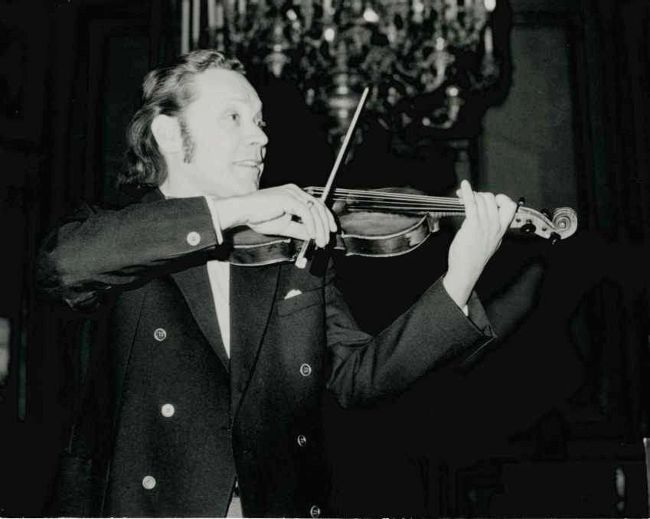
Eduard Melkus performing in Vienna in the 1960s
Violin lovers have a special place in their hearts for Viennese iddlers, and they happily reel of the great names: Fritz Kreisler, Erica Morini, Wolfgang Schneiderhan, Willi Boskovsky, Walter Barylli…and Eduard Melkus, who turned 90 last September. Of them all, Melkus, who barely plays now, is the most versatile. Renowned as an early music pioneer, he has also played music by Hindemith and Webern, Bartók’s Solo Sonata and Viola Concerto and the violin concertos by Berg, Reger (rather cut), Schumann (his own edition, incorporating some of Kulenkampf’s and Hindemith’s changes) and Wellesz, which he premiered in 1962. He led quartets in Switzerland and America and either directed or conducted his own chamber orchestras in Baroque and Classical repertoire.
He was born in Baden near Vienna on 1 September 1928 to parents who played music for pleasure – mostly the piano. His father, an official in the inance ministry, and his aunt commanded a vast range of four-hand pieces, and it was his mother who encouraged his ambitions: ‘It was against the family tradition to become professional,’ he tells me. ‘Musicians were considered a little bit like vagabonds – which we are!’
Given an old iddle as a toy at the age of four, he started the piano aged six; but at the age of seven he demanded a proper violin and had lessons with a Ševčík pupil whose name he forgets. After a year he changed to Adolf Siebert (later known as Adolphe Sibert), who told Melkus when the Anschluss came in 1938: ‘I am Jewish and I have to leave.’ So the boy continued with Jaro Schmied. At his gymnasium he encountered Bruno Sonneck, the first of two polymaths who would inspire his lifelong quest. A conductor, educator, pianist, cellist and organist, Sonneck had doctorates in Latin and music. Melkus recalls, ‘He played musically and introduced me to early music. We were very close friends, but separated at the end of the war.’
In 1943 Melkus entered what is now the University of Music and Performing Arts, Vienna to study both violin and viola with Ernst Moravec (Schneiderhan Quartet violist and principal viola of the Vienna State Opera Orchestra and the Vienna Philharmonic), with whom he would stay until 1953, and of whom he now says, ‘He could play all the concertos better than we could.’ Meanwhile, a second polymath–mentor came into his life: Josef Mertin, whom he describes as his ‘guide and friend, a fine singer full of life, temperament and real musicality’. Mertin, whose repertoire reached back to Pérotin and Machaut, directed Collegium Musicum and the Vienna Chamber Orchestra, both of which Melkus led from 1946.