TRACKERS
Relive the history of tracker music
Michael Reed looks at the history of so-called tracker music and explores some of the Linux tools that can work with that format.
OUR EXPERT
Michael Reed has been messing around with computer music since the late ’80s. Fortunately, none of these early efforts have survived.
Tracker music first arrived in the early ’80s on the Commodore Amiga series of T computers thanks to a program called The Ultimate Soundtracker. This music application and its clones laid down the foundation for the entire tracker music scene, a scene that is still alive today. Because tracker files contain the note data that makes up the song alongside the sample data for the instruments, it was quickly embraced as an ideal format for game music as well as by amateur musicians who wanted to share their music.
Right from the beginning, music trackers attracted a huge community, and it helped that the format was open from early on. This meant musicians could open existing trackers to see how they work, while programmers could develop their own tools, players and editors. At this point, there are tens of thousands of tracker tunes floating around the internet, and there are modern tools to create and play tracker tunes.
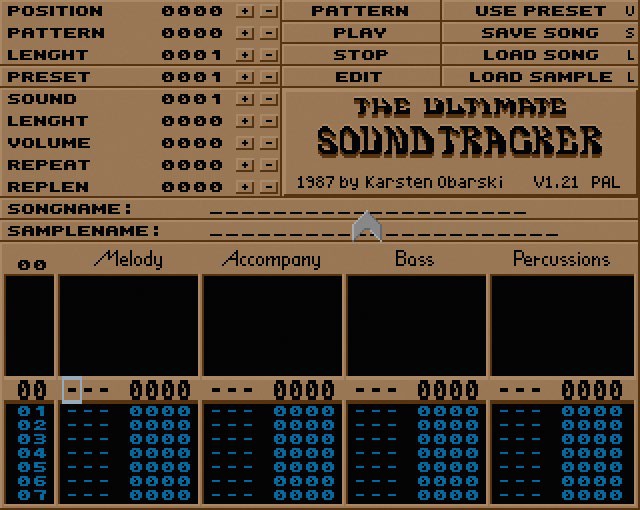
The Ultimate Soundtracker (1987). Later trackers refined the concept, but all of the elements were established here.
The tracker interface is different from a typical music sequencer, and it’s particularly attractive to programmers and non-musicians. Rather than having to learn musical notation or the skills needed to play an instrument, the user works with columns of numbers and letters, each column representing a single sound channel. As often as not, the QWERTY keyboard is used rather than a music keyboard to input the notes. Considering the spreadsheet-like interface, mixed with the immediate gratification of keyboard bashing to make the sounds, no wonder trackers have always appealed to the amateur who wanted to make a tune. Here we’re looking at how trackers evolved and what it takes to work with trackers on Linux PCs now.
Commodore Amiga
Did you know that the Commodore Amiga was originally going to be the Atari Amiga? A chap called Jay Miner was the main hardware architect of the Amiga, and he had been the principal designer of two previous Atari machines. The Atari 2600 (released in 1977) was a cheap, cartridge-based games console with limited specs and amazingly flexible graphics hardware. The Atari 8-bit range of computers (which began in 1979) took some of the ideas further with cleverly designed graphics hardware that made the most of limited specs. Due to a falling-out on the business side of things, Commodore rather than Atari ended up as the owner of the Amiga property. In many ways, the Amiga was a more direct successor of those early 8-bit designs than any earlier Commodore model.
What made the Amiga a landmark computer achievement was the combination of Miner’s amazing graphics and sound hardware with a lightweight workstation-style OS. Frankly, in 1985 when the Amiga A1000 was released, you’d have to spend about the same as a typical new car to afford a computer that could outdo everything the Amiga could do. The fourchannel 8-bit audio system was also unique, and that’s what we’re concerned with here because these were the specifications that shaped the earliest trackers.