ISLANDERS for the Islanders
One of Britain’s smallest yet most successful airliners, the Britten-Norman BN-2 Islander, is big in Germany,
as Andreas Rohde discovers
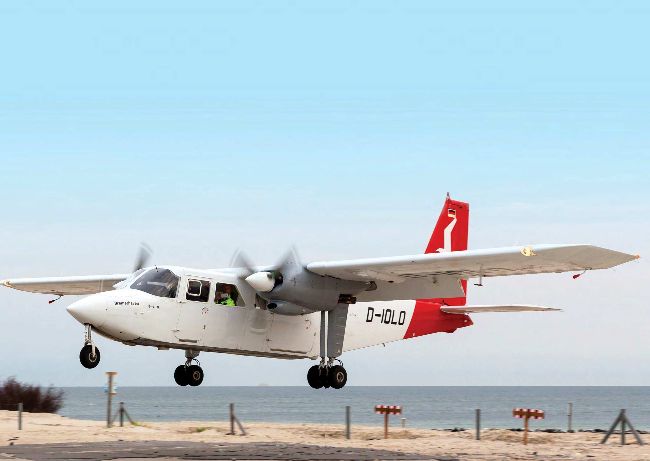
•
An
OFD
Britten-Norman
BN-2
Islander
landing
at
Heligoland
AIRTEAMIMAGES.COM/
DANISH AVIATION PHOTO (ALL OTHER IMAGES BY ANDREAS ROHDE)
The East Frisian and North Frisian Islands line Germany’s North Sea coast from the country’s border with the Netherlands in the west across to Denmark in the northeast. These two chains of islands are incredibly beautiful, with huge sand dunes and endless beaches, making them popular with tourists year-round. However, the weather and tidal conditions in the Wadden Sea don’t always favour ferry operations. Most of the islands have their own airfields, but runways are short and winds coming off the North Sea can prove challenging.
It’s a natural habitat for the Britten-Norman BN-2 Islander.
No fewer than 14 examples of the British-built workhorse provide vital links between the Frisian Islands and the mainland under the demanding conditions. Ten of the piston-powered commuters are operated by Frisia Luftverkehr Norddeich (FLN), with the other five being flown by Ostfriesischer Flug Dienst (OFD). Both companies have a long operating history of this unique and successful British airliner.
When discussing successful airliner designs, the small Brit is often overlooked. Yet considering the length of its production run and the numbers in which it has been built, the BN-2 Islander is one of the most successful aircraft that Britain has ever created. Since 1965, more than 1,280 airframes have been produced. Development work on the Islander – appropriately named, as it was to be built on the Isle of Wight – began in 1963, when John Britten and Desmond Norman began work on a regional airliner. Little known at the time, their company had produced a single ultralight aircraft – the BN-1 Finibee – and modified several de Havilland DH.82 Tiger Moths for crop-spraying use in Sudan.