The future is now
It’s not often that we feature rotary aircraft in Airliner World, but as Howard Slutsken reports, there’s something a little different going on in Vancouver...
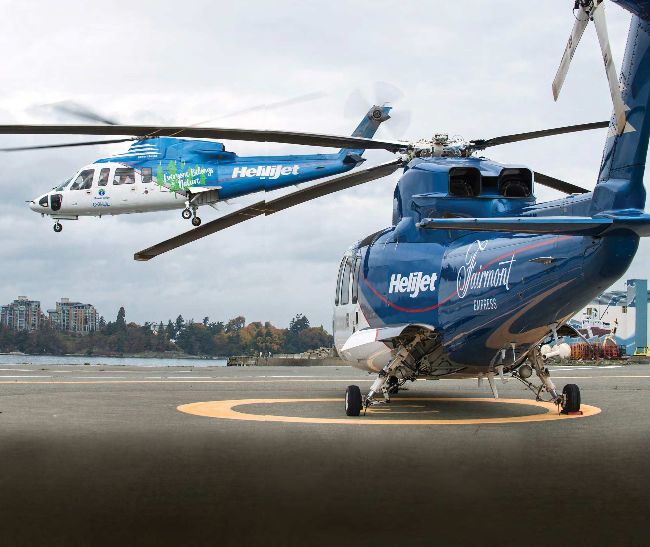
Helijet’s blue and white-liveried Sikorsky S-76s are synonymous with helicopter flights in the region
GARTH EICHEL/HELIJET
If the plethora of prototypes popping out of hangars around the world is anything to go by, urban air mobility (UAM) may well be the future of short-distance commercial aviation. Whether powered by electric or hybrid propulsion systems, the possibility of minivan-sized vertical take-off and landing (VTOL) aircraft could be the fulfilment of pop-culture promises of flying cars made as far back as the 1950s and 1960s.
However, on Canada’s west coast, a vertical-lift airline has been shuttling passengers between two major urban centres for more than three decades, long before UAM became an acronym.
Helijet International, with its fleet of 12-seat Sikorsky S-76 helicopters, has been linking British Columbia’s largest city and commercial centre, Vancouver, with Victoria, the province’s capital city, since 1986.
Located at the southern tip of Vancouver Island, Victoria’s Ogden Point Heliport is, as the crow flies, 61 miles south of the Vancouver Harbour Heliport, an S-76 flight of about 35 minutes. Helijet also connects downtown Vancouver with Nanaimo, a small city about 38 miles to the west, in just 16 minutes.
The alternative, and much slower, method of crossing the Strait of Georgia had traditionally been on a passenger ferry, a 90-minute cruise, plus driving time to and from the BC Ferries terminals.
Another option, floatplane services between the cities, pre-dates Helijet’s launch. Harbour Air continues to provide a fair-weather only, fixed-wing link between the cities and other coastal destinations.
It made perfect sense
Watching one of those float planes gave the spark of an idea to helicopter pilot Danny Sitnam – more accurately, to his wife Laura – as they drove over Vancouver’s iconic Lions Gate Bridge in the early 1980s.
“She looked at it and asked: ‘You know, how come you don’t run your helicopter back and forth?
Wouldn’t that be more technologically advanced than running a seaplane?’” said Sitnam, Helijet’s president and CEO, in an interview with Airliner World. “I started thinking about it – an IFR [Instrument Flight Rules] helicopter that could fly in inclement weather. I could fly early in the morning and late at night, and I could upscale the service. A lot of businesspeople were using the seaplanes, and as I dug into it, I found out that it was mostly business and senior government [people] going back and forth.”