DISINTEGRATION
THE CURE
In the ego-strewn music industry, it’s often assumed that anyone who sets foot on a stage wants to be as successful as possible. This is not always the case. Creative motivation does not necessarily equate to commercial desire, a fact borne out by The Cure.
In August 1989, the band arrived in New York to begin the US leg of their The Prayer tour, to promote eighth album Disintegration. The first concert was at New Jersey’s Giants Stadium, with 44,000 people turning out to watch them headline a bill that included the Pixies. Many bands would have been overjoyed by such a response. But The Cure, who had crossed the Atlantic by ship due to frontman Robert Smith’s and bassist Simon Gallup’s profound fear of flying, were mortified. “It was never our intention to become as big as this,” declared Smith. “Despite my best efforts, [we had] actually become everything that I didn’t want us to become: a stadium rock band.”
Smith’s bewilderment was heightened by the knowledge that, after six years of releasing giddy, oddball pop hits, he had written Disintegration, a deeply personal album of near-relentless gloom. The very last outcome he’d envisaged was a surge in sales. As one NME journalist put it at the time: “How can a group this disturbing and depressing be so popular?”
Disintegration would go on to become The Cure’s finest work, created by a band at the peak of their powers. Smith’s dark ruminations of lost love and despair would transform the band from cult status to mainstream adulation, with posters of them adorning the walls of teenagers’ bedrooms across Middle America.
The Cure were always the unlikeliest of pop stars, goth-rock royalty effortlessly straddling a hip, intelligent post-punk aesthetic with kooky pop sensibilities. Over the course of one of the industry’s longest and most bizarre careers in music, the band endured numerous line-up changes, acrimonious feuds and alcoholism. But they have remained revered and respected in equal measure.
The suburban no-man’s land of Crawley in West Sussex was the birthplace of the band initially called Easy Cure, formed in 1976 by school friends Robert Smith (vocalist, guitarist and principal songwriter), Michael Dempsey (bass) and Laurence ‘Lol’ Tolhurst (drums). They forged a jagged, edgy kind of pop with lyrics inspired by literature, as evidenced on the Albert Camus-inspired demo Killing An Arab in 1978.
This demo attracted the attention of Chris Parry, A&R at Polydor Records, who persuaded them in 1979 to sign to that label’s subsidiary, Fiction.
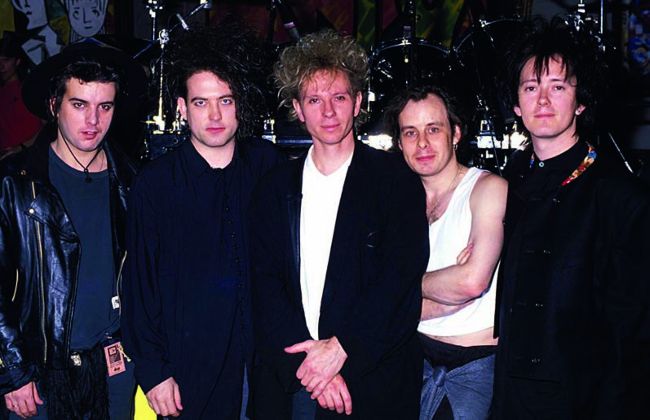
The Cure attend the 1989 MTV Video Music Awards
© Getty Images
THE PLAYERS
ROBERT SMITH
Now 60 and still rocking the allblack togs and slathered-on makeup look that has been his trademark for the past four decades, Robert Smith is still going strong as The Cure’s quietly charismatic frontman. Concurrent to his early work with The Cure, Smith was lead guitarist for Siouxsie And The Banshees from 1982 to 1984, and also part of the shortlived Banshees splinter group The Glove.
SIMON GALLUP
Gallup joined The Cure in 1979, replacing Michael Dempsey on bass guitar. He left in 1982, following a fist fight with Robert Smith in a
Strasbourg nightclub and formed The Cry (later Fools Dance) a year later. In 1984, he rejoined The Cure and has remained with them ever since (aside from a short break in 1992, when he was admitted to hospital with pleurisy).
PORL THOMPSON
Thompson was, along with Robert Smith, Michael Dempsey and Lol Tolhurst, part of the original lineup of The Cure, when the band formed in 1976, but had signed up to art college by the time they released their debut album. He eventually rejoined in 1983 and would stay with the band for 11 years before leaving to play with Jimmy Page and Robert Plant during their
1995 Page And Plant tour. He rejoined The Cure in 2005 and remained with them until 2012 when he departed the group for the third time.
BORIS WILLIAMS
Before joining The Cure, the Versaillesborn Williams had worked with Thompson Twins, Kim Wilde and Strawberry Switchblade, among others. He became The Cure’s drummer after the sacking of Andy Anderson in 1984 and remained with the band for 10 years. He later formed the short-lived worldbeat supergroup Babacar with former members of Shelleyan Orphan and Presence.
ROGER O’DONNELL
O’Donnell had, prior to joining The
Cure, played in Thompson Twins, alongside future Cure bandmate and drummer Boris Williams. He became The Cure’s new keyboard player in 1987 and became a fully integrated member on the Disintegration album (his songwriting talents can be heard on the B-sides Out Of Mind and Fear Of Ghosts). He remains with the band to this day.
LOL TOLHURST
Though credited with “other instrument”, it’s been claimed that Tolhurst, despite being a member of the band during the making of the album, didn’t play on any track. Having known Robert Smith since childhood, Tolhurst was fired from the band following the completion of Disintegration. He did, however, briefly rejoin The Cure for a run of reunion shows in 2011.