GHOSTS IN THE MACHINE
Uncovering the secrets of Animal Well, Tunic and UFO 50
By Alex Spencer
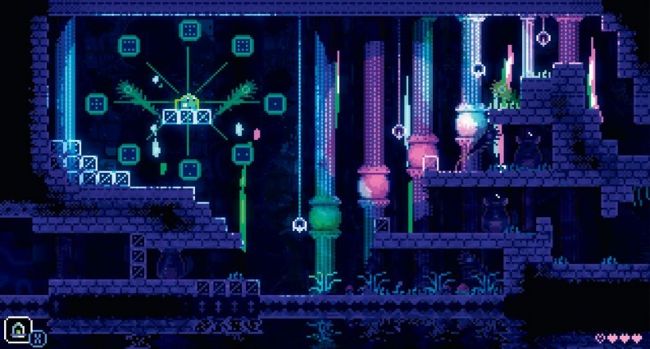
Directional inputs are a common part of the secret-finding process, recalling both the Konami code and
Ocarina Of Time
’s secret songs
For the young Billy Basso, it was Super Mario Bros 3. “It was such a profound memory to me that I can still picture it to this day,” the developer says, his eyes going a little soft-focus. “I was at my neighbour’s house – they used to babysit me when I was three or four years old – and they had a 13-inch CRT television sitting on their dining-room table, set up to play NES.”
On that TV, the neighbour demonstrated a trick. “It’s maybe the third stage, and you have to get on the white block and hold down for a while,” Basso says, “and it drops you down into the background, behind the set dressing of the level.” Waiting there, in this place that breaks the established rules of 2D space, is a treasure chest. And inside, the Warp Whistle, allowing the player to disrupt the natural flow of Mario levels. “It was like this weird breakthrough in my little brain,” Basso says.
The influence of this formative moment can be traced throughout the developer’s entire career. Even during his time making medical training games at Chicago’s Level Ex, Basso couldn’t resist hiding little Easter eggs inside of endoscopy simulators. “There was this one case where you’d remove a nail from someone’s lungs,” he explains. Your equipment included forceps to tug it free, and “an APC gun” for cauterising the wound; he programmed a shader so that, if the APC was aimed at the nail, an electrical charge would arc to it “like the Force lightning from Star
Wars”. Since it wasn’t medically accurate, he was told to remove it, but Basso was pleased with the effect he’d made. “So instead of taking it out, I just disobeyed my producer – and made it so it only happens one out of 100 times.”
Those of us who have never trained to perform lung procedures, however, might be more familiar with the project Basso began making out of hours during those Level Ex days. A game over which he had total control, even programming its engine from scratch in C++, it was the perfect chance for him to scratch this decades-long itch.
Animal Well begins as a relatively conventional game in the Metroid vein, albeit one with a brilliantly thick, eerie atmosphere. But as you play, it gradually introduces things that don’t quite seem to fit: items that have no obvious uses, or else have extra utilities you discover by accident and can’t quite fathom a need for; hidden passageways that link the map in unexpected, looping ways; and a giant groundhog that ducks back into its hole whenever you get too close, responding the same way no matter what new tools or abilities you bring to bear.
“I always wanted another layer beside what you are doing, in the background, to tease you and give the sense that, ‘Oh, there’s more here’,” Basso explains. “There’s always a loose end, trailing off into the distance.” He talks about the game’s structure in terms of layers, the first of which is the relatively short journey to reach the ‘ending’. After the fireworks have gone off and the credits rolled, you’re ushered into a new area that opens up fresh mysteries, then dropped back into the world. It makes clear that everything to this point was just the tip of the iceberg. What hides underwater, in the remaining layers, is some of the game’s most inventive, virtuosic design – a string of secrets that require reconfiguring your brain, much as their maker’s was once reconfigured by the Warp Whistle.
RENENEEN THE FIRST TINE YHU CNAN. SOMETHING NIDENGMNE JLDN'T THERE
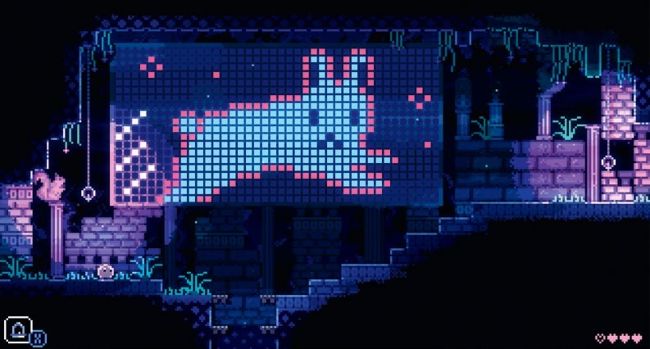
This leaping-rabbit mural teases one of
Animal Well
’s finest secrets, requiring the combined efforts of at least 50 players to solve
“I still think of it as a puzzle that I’m designing,” Basso says. “It’s just either a harder one or one that has a layer of obfuscation.” But these secrets were harder to design than your average puzzle, he adds. “Each one is a kind of anomaly that’s breaking the rules of the game in some unique way. It doesn’t follow a framework. It was dependent on me having these little sparks of inspiration. So I could only come up with one every three months or something.” Basso’s solution to this problem? Simply to keep making the game for seven years.
Along the way, ideas emerged in various ways. Some grew out of unintentional bugs, including one that allowed players to die and respawn in an area they shouldn’t be able to reach – rather than fix it, Basso decided to build a puzzle around it. Others came from studying the component parts he had to work with, finding novel applications for them. “I was thinking of Metal Gear Solid and how that breaks the fourth wall by making you check the game packaging or reading your Memory Card data,” he says. “I wanted to do something like that: ‘How can I use the hardware in surprising ways?’ I think it helped that I had full control over the game engine, so I was able to tap into some of the weirder APIs – using the printer functionality and stuff like that.”