i got my own world
A manifeste of musical and spiritual freedom, Axis: Bold As Love was JIMI HENDRIXar his most exploratory, utopian. But as a new box set explores, notes of unease and psycho-autobiography cut through the Aquarian haze and freaky, proto-stereo FX, as the Summer of Love entered its more conflicted autumn. "It was all vivid colour," peers and Fhu tell MARK PAYTRESS, "with Jimi at the height of his powers."
Portrait by FIONA ADAMS
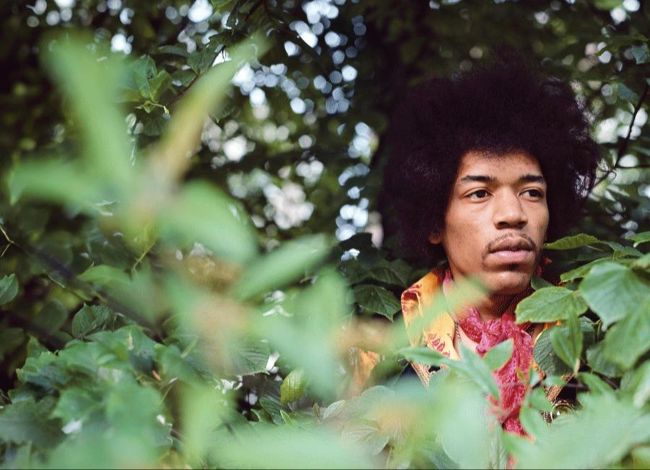
In bloom: Jimi Hendrix in his Lincoln hotel garden during his first UK tour, April 1967.
Fiona Adams/Getty
ON MAY 17, 1967, AT THE BBC’S TOP OF THE POPS STUDIO in west London, Jeff Beck spotted a familiar face on a television monitor. Turning to journalist Keith Altham, he joked: “Look at Hendrix – isn’t he a card!” Six months earlier, Beck had seen Hendrix at in-crowd hangout Blaise’s and left telling The Who’s Pete Townshend that their careers were as good as over. Now, waiting to perform Hi Ho Silver Lining, his surprisingly bland first solo 45, Beck expressed concern for his rival.
“Jimi’s only trouble will come when he wants to get off the nail he’s hung himself on,” he told Altham. “The public will want something different. And Jimi has so established himself in one bag he’ll find it difficult to get anyone to accept him in another.”
Five days earlier, the first Jimi Hendrix Experience album, Are You Experienced, had hit the racks. Soon, it went to Number 2 in the UK chart, tucked in behind The Beatles’ Sgt. Pepper’s Lonely Hearts Club Band. All the promise of the group’s first two singles – moody murder ballad Hey Joe (UK Number 6) and druggy Purple Haze (Number 3), was fulfilled by an 11-strong set of Hendrix originals, mostly explosive psychedelic rock with ventures into space (3rd Stone From The Sun), mystic R&B (May This Be Love) and Jimi’s own ‘classic’ blues (Red House). The Monkees aside, Hendrix was the biggest story in pop that spring.
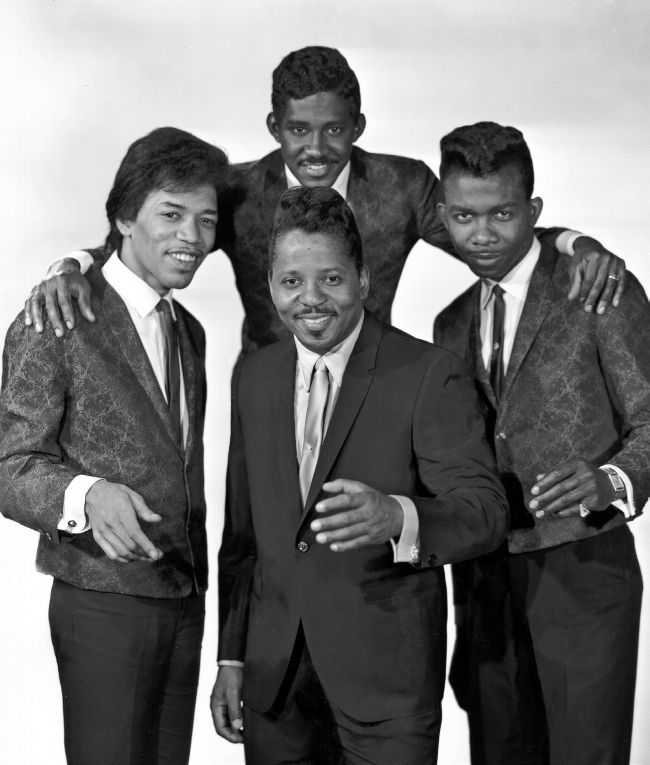
Sunny Jim: (above) Curtis Knight & The Squires, 1965 (clockwise from left) Hendrix, Marion Booker, Ace Hall, Knight; (right) The Jimi Hendrix Experience (from left) Mitch Mitchell, Noel Redding, Hendrix.
Getty (2), Shutterstock (2), Starstock/Avalon
It was ex-Animals bassist-turned-aspiring manager Chas Chandler who’d spotted Hendrix’s potential, springing him from a basement club in New York’s Greenwich Village and bringing him to London in September 1966. Hendrix’s background had been as a sideman to leading R&B acts including James Brown, Curtis Knight, Isley Brothers and Ike & Tina Turner, though by summer ’66 he’d been performing contemporary pop including The Troggs’ Wild Thing and Dylan’s Like A Rolling Stone with his own band.
The ambitious Chandler teamed him with ex-Georgie Fame drummer Mitch Mitchell and ex-Loving Kind guitarist-turned-bassist Noel Redding, fully intending that their respective jazz and pop influences would fuse dynamically with Hendrix’s grounding in blues and R&B. That October, Hendrix had sat in with Cream, Britain’s leading jazz-schooled blues-rock power trio, and scared guitarist Eric Clapton to death. Present was neophyte Pink Floyd bassist Roger Waters. “Very impressive,” he told me years later. “For about six months I thought his name was Junior Hendrix.”
WATERS WAS SURELY THE EXCEPTION BECAUSE that winter Hendrix’s name spread like wildfire though fashionable London. Various Beatles and Stones were quickly onto him, as was virtually every guitarist in town. “It took him about three gigs in London to become the man,” Move guitarist Trevor Burton told me. “I saw him at the Saville Theatre on a Sunday night, one of the first big gigs there [January 29]. I was sitting in the same row as Beck and Townshend and everybody was gobsmacked. Fucking hell! How d’ya do that? He changed the face of British music.”
Musically, The Jimi Hendrix Experience were electrifying, and the sonic thrills were more than matched by Hendrix’s outrageous showmanship, encouraged by Chas Chandler. On March 31, 1967, at the opening night of a package tour headlined by The Walker Brothers and Engelbert Humperdinck, Keith Altham suggested that Hendrix should set fire to his guitar to further arouse the press. Chandler leapt on the idea, and provided lighter fluid. Hendrix’s star just grew brighter.
Despite Jeff Beck’s misgivings, The Wind Cries Mary, the song Hendrix plugged on TOTP, couldn’t have been more different from the hype. Soulful, downcast, an early showcase for Hendrix’s louche balladeer voice and graced with some bittersweet, Curtis Mayfield-style guitar phrases, the song rebuffed everything the public thought it knew about pop’s latest, most controversial figure.
“This is no hard-sell, ram-it-down-their-throats pop record for the masses,” praised Melody Maker, welcoming the shift in style. “[Here’s] Hendrix in his true flying colours – a lyrical poet combining the deepest feelings with an overpowering, all-enveloping atmosphere and presence.”