Uncommon People
Thirty years since their Glastonbury '95 apotheosis, and 24 since their last album appeared to call time on their recording career, PULP have a new album and a new lease of life. An art pop anomaly in thrift store drape, with an original take on the human comedy, they survived obscurity, fame and disillusionment to enjoy arena-filling vindication. Now it's clearer than ever: there's nothing like them and there never will be. "Pulp has always mutated and now it's mutated again," they tell IAN HARRISON.
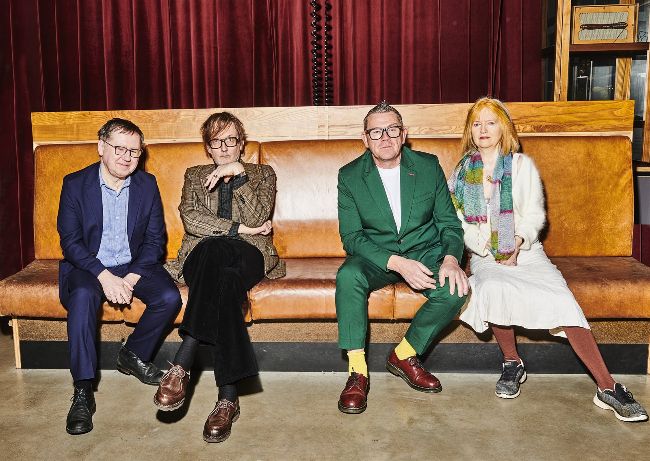
The old razzle dazzle: Pulp at Spiritland Studio, London, February 4, 2025 (from left) Mark Webber, Jarvis Cocker, Nick Banks, Candida Doyle.
Photography by TOM JACKSON
JUNE 24, 1995. TONIGHT, THE GLASTONBURY FESTIVAL WAS to play host to one of the defining bands of the era. Or it would have done, had Stone Roses guitarist John Squire not broken his collarbone while mountain biking outside San Francisco earlier in the month.
Who would step in at the last minute? Primal Scream, Guns N’ Roses and Rod Stewart reportedly declined. Instead, taking time out from recording their fifth album, Sheffield’s Pulp stepped into the breach. The decision would change their lives forever.
Pete Hill, Kevin Westenberg
They weren’t exactly an unknown quantity. Part of the Britpop boom, they’d scored a UK Number 2 single with Common People a few weeks earlier. Even so, it was a gamble. Pulp had been toiling on the furthermost margins for years and finally started to accrue notice in the early ’90s with idiosyncratic, charity shop-futurist songs of sex and intrigue. Charismatic singer Jarvis Cocker was given to nervy interpretative dance and tangential asides: would they rise to the occasion on the Saturday night big stage?
“I’ve never been as nervous in my life as for that concert,” says Cocker. “We hadn’t played for ages and Common People had only just been a hit, but it worked.”
The crowd’s appreciation of Pulp’s pluck built into rapt delight in their relatable songs. Enjoying its public debut, Sorted For E’s & Wizz addressed the festival drug experience conspiratorially. At the set’s climax, tens of thousands lent their voices to Common People’s anthemic parable of class, privilege and sex.
“I’d never had people sing along with a song before, certainly not at that volume where I thought, They’re louder than me,” says Cocker. “It was the first time I realised we had gone into another area, and that life had changed. It was perfect, one of those unforgettable moments.”
Not every member of Pulp, however, was as convinced they’d smashed it. Guitarist Mark Webber remembers wayward violin playing, among other flaws immortalised in the BBC’s TV coverage.
“I thought it wasn’t a very good concert at the time,” he says. “We remixed the live recording of Common People as soon as we had the chance, but the BBC never synced the video with the remixed version, so whenever they repeat it, the balance of the instruments is all out of whack. People loved it, though.”

Part of the masterplan: Pulp in 1983 circa the Everybody’s Problem single (from left) Tim Allcard, Saskia Cocker, Jarvis Cocker.
Pete Hill, Kevin Westenberg
“I watched that on telly at home in Sheffield with my two-yearold daughter asleep on my lap, on a rented TV you had to put 10 pence pieces in,” recalls Richard Hawley, an old friend of Pulp’s and later, a bandmate. “Jarv made me fucking cry, the bastard. Tears rolling down my cheeks, being so happy that one of us had got away.”
Pulp went on-stage as one band and came off another. Within the year, that fifth album, entitled Different Class, hit UK Number 1 and later won the Mercury Music Prize. Jarvis Cocker, who’d made a bargain with pop fame as a teenager, was about to get what he’d always wanted.
NEARLY 30 YEARS LATER, ON FEBRUARY 12, 2025, IN the west London offices of the Rough Trade label, Cocker is preparing for his first in-depth interview as Pulp’s singer for more than 20 years. Sat beneath several portraits of a younger Jarvis, he’s still recognisably himself, with thick-framed specs, double-breasted green check jacket, dark roll-neck and cords. Curiously, he has very long thumbnails. “Be patient with me,” he says, in soft and resonant south Yorkshire tones.
There’s much to discuss. Since 2023, Pulp – Cocker plus Webber, keyboardist Candida Doyle and drummer Nick Banks – have been playing gigs again, the line-up augmented by players from Cocker’s most recent solo vehicle Jarv Is. As he gave away in loose talk with a passing motorist in north-east London last August, the expanded group have been at work on the first new Pulp album since 2001’s We Love Life. To be released on June 6,
More. is what many Pulp fans have been waiting for since Different Class: a restatement of their founding virtues as a pop group, with age-appropriate but still penetrating narratives, tunes galore and a renewed sense of purpose. The obvious question: why now?