FILTER REISSUES
London’s Burning
Newly released 1970 UK concert film and accompanying soundtrack album show how cool CCR really were.
By Mat Snow.
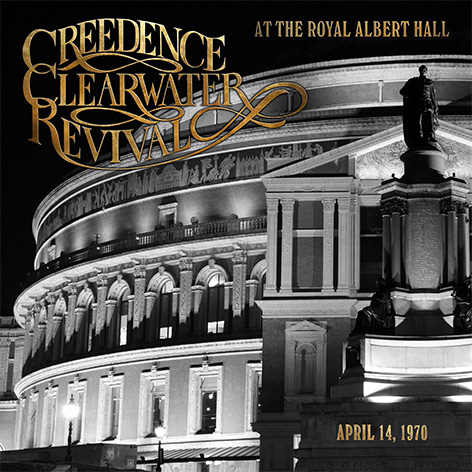
Creedence Clearwater Revival
★★★★
At The Royal Albert Hall
CRAFT. CD/DL/LP/MC
“PEOPLE HAVE been on to me to put out a ‘live’ album by the group but so far I have refused,” declared Creedence Clearwater Revival’s singer, songwriter, lead guitarist, bandleader, record producer and manager John Fogerty in April 1970. He was talking to the late Roy Carr, on walkabout in London on their first European tour as documented in Travelin’ Band: Creedence Clearwater Revival At The Royal Albert Hall, the film co-released with this album. “To me most live albums are a shuck… a cheap way of turning over a lot of money. Of all the many concert albums available there have only been three that have been worthwhile, one of which was by Ray Charles.”
Fogerty did, however, countenance concert films, hence audio recordings of not only the band’s Woodstock performance back on August 17, 1969 (which he nonetheless vetoed from the original movie and soundtrack album) but also their January 31, 1970 homecoming show at the Oakland-Alameda County Coliseum Arena for a TV special (shelved when overtaken by events). Though no live album was released during CCR’s lifetime, it’s fortunate for us that their record company Fantasy, who Fogerty fought for years in bitterly acrimonious litigation, declined to honour his wishes.
Far superior to the 1973 release Live In Europe (from September 1971 shows when CCR were down to a trio after John’s older brother Tom quit), The Concert (1980) was originally marketed as The Royal Albert Hall Concert due to a mislabelled mastertape before being correctly identified as the Oakland show. An absolute barnstormer that stands comparison with the Stones’ Get Yer Ya-Ya’s Out and The Who’s Live At Leeds recorded just weeks either side, The Concert is not just one of the most exciting live rock’n’roll albums you’ll ever hear but the yardstick by which every other CCR album, live or studio, should be judged.
Precisely because Creedence – unlike the Stones, Who, Doors and so many other rock bands of the time – kept their studio work simple, punchy and unadorned, there’s little lost in translation from the studio to the stage and much to be gained on a good night with decent live recording. Driven and drilled by their leader – ahardly less exacting taskmaster than James Brown – CCR delivered every night, not least thanks to drummer Doug Clifford and bassist Stu Cook, one of the great undersung rock’n’roll engine rooms; while his overbearingly talented kid brother commanded the stage, rhythm guitarist Tom kept his head down.
It would all blow up within months of their own universe.” this show, but what a fantastic gumbo the pressure cooker produced. Though a third the size of the Oakland Arena and with a more sedate crowd than the apeshit ravers we see in a snippet of homecoming show footage, the Royal Albert Hall hosted another night of triumph earning a 15-minute standing ovation, even if what we hear now doesn’t quite match Oakland’s sizzling synergy of performance, venue, home crowd and recording quality, notwithstanding the RAH restoration and mix by Giles Martin and engineer Sam Okell. Another British Beatleist, Bob Smeaton, directs the movie with a blandly upbeat script voiced by Jeff Bridges doing his best to restore cool to what should be an effortlessly cool enterprise.
Ed Caraeff
“Creedence Clearwater Revival created their own universe.”
What’s cool, of course, is not a fixed property but changes over time and perspective. In 1970 CCR were hugely popular but not exactly cool, not least because they were so popular among the wrong people: dancing teens, singles-buyers, musical unprogressives who dug that they kept their songs snappy and rockingly redolent of the 1950s, and on-stage played just like the records, almost to the very second with no jams, stretching out or drum solos – nor even guitar solos in the Hendrix/Clapton/Beck/Page ad infinitum sense. Whereas by 1970 live rock bands routinely performed for over an hour and sometimes two, CCR played a tight 45 minutes, not much longer than the wham-bam-thank-you-ma’am moptop sets of 1964.
Nor were CCR hippies, despite their long hair and pro-civil rights, anti-Nixon and ’Nam stance. Indeed, Fortunate Son (included here) is one of the toughest songs protesting that war, and Creedence had armed forces fans aplenty, not least because John Fogerty and Doug Clifford had actually been drafted themselves in 1966, albeit not serving overseas. Though a Bay Area band, Creedence were outliers in the Haight-Ashbury hippy hierarchy. Over 50 years on, however, it’s the outliers who’ve lasted best: Sly And The Family Stone, Santana, Steve Miller Band and CCR. They’re the cool ones now because they made the best records and played the best shows, in this writer’s opinion, rather than Country Joe And The Fish, Quicksilver Messenger Service, Big Brother And The Holding Company, even, perhaps, Moby Grape and Jefferson Airplane. (The Grateful Dead remain their own carefully cultivated universe apart.)
Creedence also created their own universe. Every set started with Born On The Bayou then Green River, and Proud Mary never failed to show up. The second song was a rare Fogerty foray into an actual memory, the childhood summer holiday spot Putah Creek in Northern California, but listeners could be forgiven for assuming it was the same Deep South waterway plied by the ‘riverboat queen’ named in the third song flowing into the swamplands of the first. Like Robbie Robertson from Toronto and Jagger and Richards from Dartford, Fogerty from sleepy El Cerrito almost method acted his way into the skin of the bluesmen and rockers he revered by imagining their worlds; in Fogerty’s case drawn as much from Mark Twain as old song lyrics.
Over 50 years on, it remains a remarkable achievement, not just for its ambition but its execution: the backbeat straight outta Memphis, the Little Richard-alike holler, the guitars a steamy, shivering heat haze with alligator teeth. Decades of ill-will within band and record company have ill-served the legacy of this great group. This excellent release helps redress the balance.