FILTER REISSUES
After-boom delights
An exemplary overview of what happened after folk music exploded across America. By Jim Irvin.
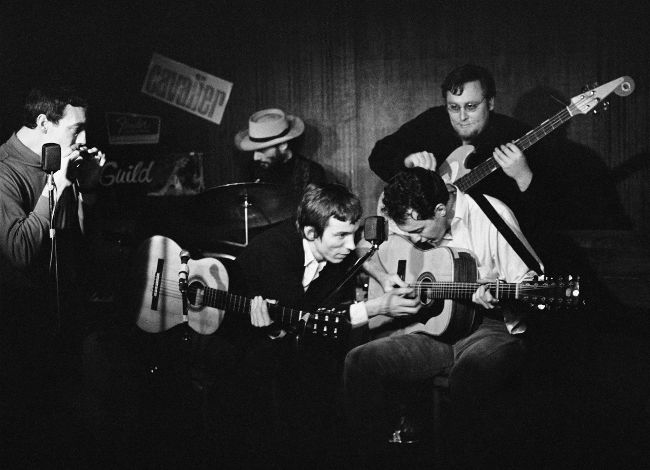
Folk odyssey: Fred Neil (second right) and band performing at the Cafe Au Go Go, Greenwich Village, New York, 1965.
Don Paulsen/Michael Ochs Archives/Getty Images
WHEN ALAN LOMAX recorded key practitioners of folk and blues for the US Library Of Congress in the 1940s, he effectively pickled and preserved the music, but folk, by definition, lives in the blood of its performers, ready to mutate and re-emerge to influence future generations. Lomax understood that to record traditional or regional music was not to ossify it but to provide a portal towards future musics, to enrich the culture yet to come. It took several years for his recordings to do that, but there’s no doubt that with the folk and blues booms of the ’50s and ’60s, they surely did.
In 1955, Pete Seeger wrote Where Have All The Flowers Gone, loosely adapted from a Russian song, a pretty thing sired by Cold War dread and Seeger’s blackisting in the McCarthy era – he maybe saw himself as an invisible flower – which remarks on the waste of young lives to warmongering. A superb new 4-CD compilation named after the song’s refrain, When Will They Ever Learn? ★★★★ ★(Cherry Red), overseen by veteran music writer and publicist Mick Houghton, brilliantly demonstrates how the dreams of Lomax and Seeger played out; how the culture was, indeed, permanently enriched.In
By the turn of the ’60s, much like skiffle had galvanised youth in the UK, folk had entered every college campus and coffeehouse in the US through the extraordinary success of groups like The Kingston Trio, who took a murder ballad, Tom Dooley, to the top of the charts in 1958. (Lonnie Donegan covered it in the UK). They sing Where Have All The Flowers Gone? here. Apparently, they thought it was a traditional song when they first performed it in 1961. (Seeger didn’t properly copyright it until 1962). It’s not angry, just matter-of-factly sad. The trio’s fellow travellers – Brothers Four, Journeymen, New Christy Minstrels etc – all sound similarly earnest and mild, their brand of folk was homespun, white and unthreatening to modern ears, though dabbling in topical commentary, often with a socialist slant that upset authority figures, just as Lomax and Seeger had ruffled the FBI’s feathers in the ’40s.
Houghton’s odyssey meanders through 100 songs chosen for their beauty, power or efficacy. Starting as the hootenannies are fading out, we hear from the scene inhabiting Greenwich Village: Bob Dylan, Fred Neil, Tom Paxton, Phil Ochs, Judy Collins, Tim Hardin, Simon & Garfunkel, and then watch that style spreading through the likes of The Byrds, Johnny Cash, Nico, Grateful Dead, Townes Van Zandt and many more, deep into the decade.
It’s the kind of compilation you can spend several evenings unfurling, enjoying its mix of key works and surprises, and appreciating the way the songs converse with one another, as the music’s tendrils extend outwards. The Brothers Four sing 500 Miles written by banjo player and singer of Appalachian ballads Hedy West, whose own The Davison-Wilder Blues is included; Bonnie Dobson offers up her ancient-sounding composition Morning Dew, sung here also by Vince Martin & Fred Neil; Neil’s composition Little Bit Of Rain is performed by close friend Karen Dalton; members of the The Journeymen, The Big 3 and The Mugwumps evolve into The Mamas & The Papas, and so on. Much of the lesser-known material is stunning too, tracks by Anita Carter, Tom Paley and Eric Andersen for example, plus engrossing instrumentals by Stefan Grossman and Dick Rosmini.
The Kingston Trio and their ilk may sound archaic now but, notes Houghton, the fears, concerns and challenges they sang about have endured. Israel and Iran are bombing each other as I write. When will they ever learn?