LET ME HAVE IT ALL
The passing of SLY STONE in June shone light on a genre-mashing genius whose peak, multi-hued music preached unity and transcendence. Stone's world darkened as drugs took over and The Family Stone fell apart, but the fruits of a recent, unlikely renaissance included a candid memoir and some tantalising music. “Sly still had all these amazing creative talents," discovers STEVIE CHICK.
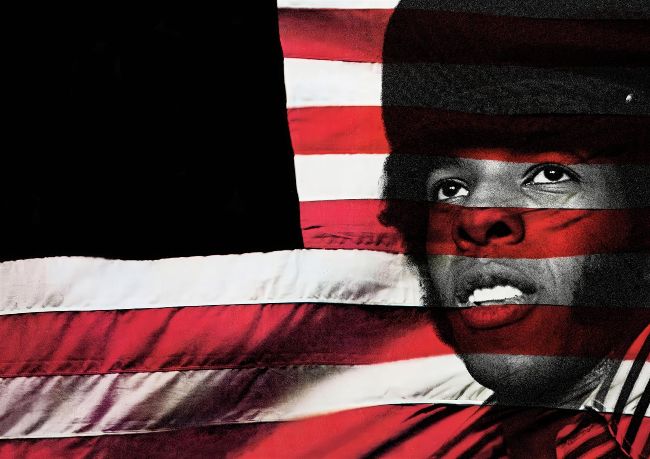
Rebel soul: Sly Stone takes a stand, 1969.
Michael Ochs Archives/Getty Images
ON A HOT, DRY MORNING IN JUNE, AT HIS HOME IN Las Vegas, Greg Errico is ruminating on the death of former bandmate Sly Stone a week earlier, at the age of 82. “It’s been challenging,” the drummer sighs. “I knew it was coming. But when it happens, there’s a lot of reflection, a lot of feelings. For me, Sly left the building a long, long time ago, and never came back.”
To many, Sly Stone had been a walking ghost for over 40 years, a funky Icarus who flew too high and was then engulfed by his addictions. After the release of his 1982 album, Ain’t But The One Way, one of the brightest stars of his age wandered into the shadows, to become a creature of rumour and whisper. And while, says author Ben Greenman, who co-wrote Stone’s 2023 memoir Thank You (Falletinme Be Mice Elf Agin), Stone had “no shortage” of opportunities to return to the spotlight, “he could not or did not seize them”.
Subsequently, a narrative of disappointment and squandered talent has haunted Stone’s legacy. “Sly is denied the read on his career granted to Jimi, Janis or Jim Morrison, because he didn’t die young,” argues Greenman, who conducted hundreds of interviews with Stone for their book. “Otherwise he’d be remembered for one of the most seamless, god-tier careers in cultural history, akin to the Pablo Picasso of music.”
Stone’s downfall confirmed him a mere mortal, but that initial seven-year burst of success told a different story, of a man for whom nothing seemed impossible. The leader of a group whose interracial, pan-gender line-up issued a joyful challenge to an America still riven by segregation and prejudice; the composer of a chart-topping fusion of soul, rock and psychedelia so revolutionary it made Miles Davis change direction. Stone danced across the stages of the Fillmore, the Woodstock festival and Madison Square Garden like he owned them. For seven or so years, he did.
Those who knew Sly Stone best are now trying to make sense of a life composed of contradictions, of glorious triumphs and tragic burnout, of love’n’hate. “You know how cats have nine lives?” asks Errico. “Sly had nine cats’ worth.”
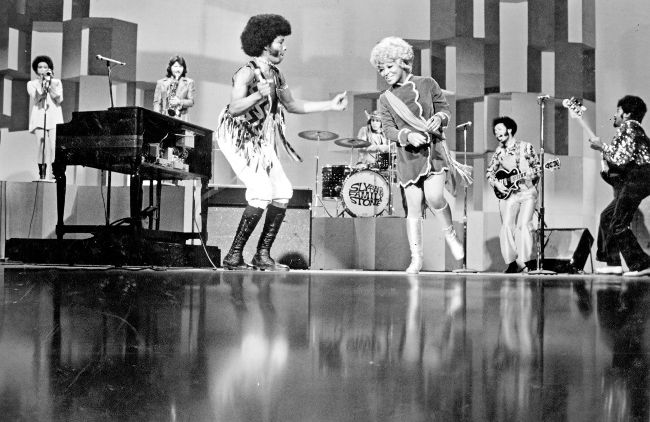
Taking it higher: (clockwise from top left) Sylvester Stewart at KSOL, San Francisco, circa 1967; Sly & The Family Stone, 1967 (from left) Sly Stone, Jerry Martini, Cynthia Robinson, Freddie Stone, Greg Errico, Larry Graham; Errico and Stone, 1968; the Family Stone, ’68, now with Rosie Stone (centre).
Michael Ochs Archives/Getty (3), Don Paulsen/Michael Ochs Archives/Getty
BORN SYLVESTER STEWART IN 1943, Sly Stone had been a star since his teens, a regular on Dick Stewart’s Dance Party, San Francisco’s answer to American Bandstand. There, he met Jerry Martini, saxophonist with Joe Piazza & The Continentals and later Dance Party’s in-house band. Martini backed Stone’s early group The Viscaynes in the show’s talent contests, and a deep friendship developed, Martini regularly stopping at Stone’s folks’ house after his regular gig at America’s first topless bar, The Condor Club. “Sly would bring out his binder full of songs he’d written,” Martini remembers. “There were already over 300 in there.”
A polymath performer with a producer/songwriter side-hustle, Stone produced his first Top 10 hit, Bobby Freeman’s C’mon And Swim (with Martini on sax), in 1964, later helping The Great Society, fronted by future Jefferson Airplane star Grace Slick, record an embryonic Somebody To Love. He was also a disc jockey, with 700,000 listeners in the Bay Area. Martini was inordinately proud of his friend – “Sly would introduce songs on his radio show, whispering into the microphone, ‘Listen to this, Jerry!’” – but he wanted Stone to focus his profligate talents. “I’d tell Sly, We need to start a band! He’d answer, ‘I’ll send for you when I’m ready.’”
That call finally came in 1966. Stone assembled members of Freddie & The Stone Souls – led by Stewart’s younger brother Freddie, and featuring a 17-year-old Greg Errico on drums – and refugees from Stone’s recently-split Sly & The Stoners, including trumpeter Cynthia Robinson and bassist Larry Graham. “It was a unique mix: male and female, black and white,” remembers Errico. “We didn’t even play music that first night, just talked about everything we were gonna do. But as soon as we started rehearsing, we discovered a natural chemistry.”