HOW TO BUY
King Gizzard And The Lizard Wizard
Navigating the Gizzverse. By Stevie Chick.
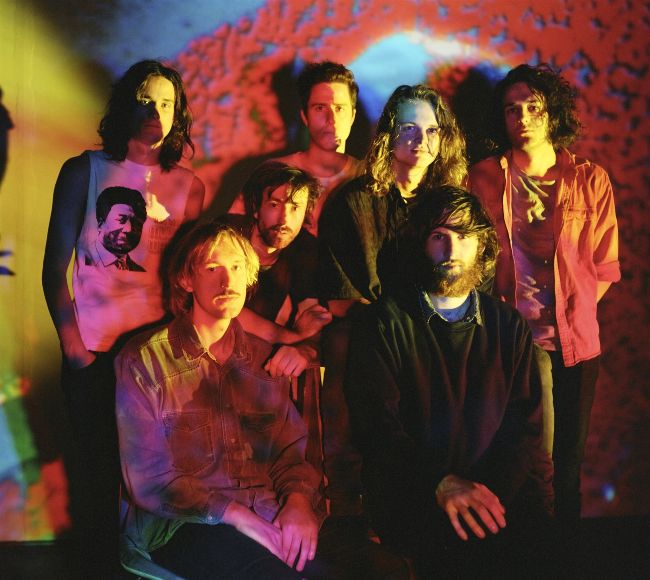
In the reptile house: King Gizzard And The Lizard Wizard, 2014 (clockwise from top left) Ambrose Kenny-Smith, Joey Walker, Stu Mackenzie, Mickey Cavanagh, Lucas Harwood, Cook Craig, Eric Moore.
Michael Ochs Archives/Getty Images
“IT’S FUN TO world-build,” shrugged Gizzard King Stu Mackenzie to MOJO in 2020, attempting to explain his group’s prolific output. Indeed, across 27 studio albums in 13 years, the Antipodean polymorphs have crafted their own universe. But ‘the Gizzverse’ doesn’t only describe the fictional cosmos encompassing concept albums like Murder Of The Universe (wherein depressed cyborg Han-Tyumi brings about a vomit-powered apocalypse) and Infest The Rats’ Nest (wherein the one per cent flee a climate crisis-ravaged Earth for Mars). It also defines the kaleidoscope of sounds the Gizz have explored, from garage-psych rave-ups to electronica, thrash metal and, on this year’s Phantom Island, symphonic rock.
Not bad for a group that formed as a drunken jam-band “with songs so simple you could learn them on-stage”. Gizzard began in 2007 in Geelong, Australia, where, following a brutal sporting injury, the 16-yearold Mackenzie spent many months of recovery learning guitar with friends Cook Craig, Lucas Skinner and Ambrose Kenny-Smith. Later, at college in Melbourne, guitarist Joey Walker and drummers Mickey ‘Cavs’ Cavanagh and Eric Moore (who exited in 2020) jumped aboard, and this unwieldy septet that “could clear a room in 60 seconds” began morphing into a globally acclaimed psychedelic-rock concern.
Restlessness set in early, however. After critics pigeonholed 2012 debut 12 Bar Bruise as garage-psych, Mackenzie dreamt-up 2013’s spaghetti western concept LP Eyes Like The Sky, to prove they “could be anything we wanted”. They’ve pursued this maxim ever since, chasing every crazy whim with remarkable zeal. Like when they fell under the spell of Turkish psychedelia circa 2017’s Flying Microtonal Banana, and custom-built bespoke guitar/ bağlama hybrids to “play the notes between the notes”. They liked the sound so much, they released two further volumes of microtonal experiments (2020’s KG and 2021’s LW); more will doubtless follow.