A CELTIC LEGACY
Ireland’s ‘Fab Five’, Horslips emerged from a troubled country to become the prog saviours of their national heritage. Fifty years on, with the release of an expansive box set featuring a staggering array of previously unavailable music, the band’s biographer takes Prog through the making of their 1972 debut album… and how it earned the wrath of Rolling Stone Mick Jagger.
Words: Mark Cunningham Portrait: Ian Finlay
Until the dawn of the 70s, live music in Ireland had been a vibrant but disorganised scene, hosted entirely in pubs, clubs and college halls that valiantly attempted to shake off the lingering post-war monochrome cloud. Though Rory Gallagher, Thin Lizzy and the Hendrixproduced Eire Apparent were among the first rock acts of note to emerge from the grey as the decade began to unravel, a more unusual outfit came through to infuse the Emerald Isle’s youth with life-affirming escapism.
In that era of devastating social and political crises, Horslips revolutionised the country’s live music landscape by cultivating a new live rock circuit, packing out ballrooms normally reserved for tuxedo-clad show bands. They also showed that it was possible to create and release music purely on their own terms, and by embracing their folk heritage they helped restore national pride while simultaneously pioneering a whole new genre.
They began life as a regular group of rock’n’rollers, but Horslips soon evolved a fusion of progressive rock and mythologylaced traditional Irish music that the media labelled “Celtic rock”. Purely accidental at first, this blend of the present and past set a template for the band to develop, most convincingly on 1973’s The Táin and 1976’s The Book Of Invasions.
To mark the 50th anniversary of their ambitious debut LP, Happy To Meet, Sorry To Part, the now-dormant Horslips have teamed up with Snapper Music’s Madfish label and curator Colin Harper to issue More Than You Can Chew – an exhaustive career-spanning box set that, in addition to the band’s fully remastered original catalogue and solo highlights, contains more than 20 hours of previously unreleased content across 33 CDs and two DVDs, along with a generous helping of memorabilia.
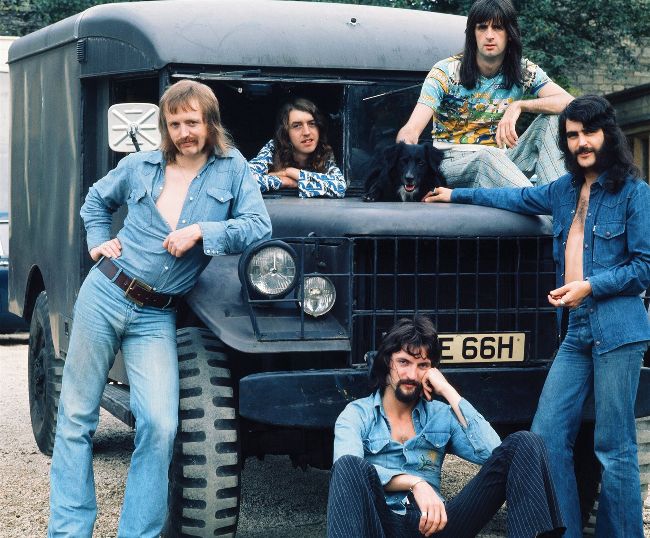
Horslips, on the road to fame.
“Apparently, Mick [Jagger] was furious about ‘this cockamamie Irish group’ getting their way when it had been such a struggle for the Stones. We thought it was hysterical.”
The collection is effectively a curtain call for the band that originally gathered in 1970 to play the part of ‘The Gentle People’ in a lager commercial, one of many projects to land in the lap of Arks, the Dublin advertising agency whose creative staff included Barry Devlin (vocals, guitar), Eamon Carr (drums), Kieron ‘Spud’ Murphy (lead guitar) and lone Englishman, Middlesbrough native Charles O’Connor (fiddle, concertina and mandolin). Adding melodic flair, Jim Lockhart (keyboards, flute and whistle) was lured away from his university studies to complete the line-up shortly before their peculiar name was conjured over a giddy Chinese restaurant luncheon.
By the end of the year, skilled photographer Murphy had fled to Sounds magazine, and with his replacement, Declan Sinnott, and the arrival of bassist Gene Mulvaney, Horslips became the resident band on RTÉ’s six-week TV series Fonn, which witnessed early performances of their ‘progressive funky céilidhe music’ including a fledgling Johnny’s Wedding, later flagged as the first Horslips single. Recorded within a year of Devlin taking over bass duties from the outgoing Mulvaney, Johnny’s Wedding was released on Horslips’ independent Oats record label on St Patrick’s Day, 1972, the day on which the band turned professional.