PRACTICE AND PERFORMANCE
Night shift On the
The night shift at Leeds City Junction in 1952 was no easy matter, not least when dealing with the four overnight sleepers that reversed at the former Wellington station in the space of an hour, as John Heaton FCILT describes.
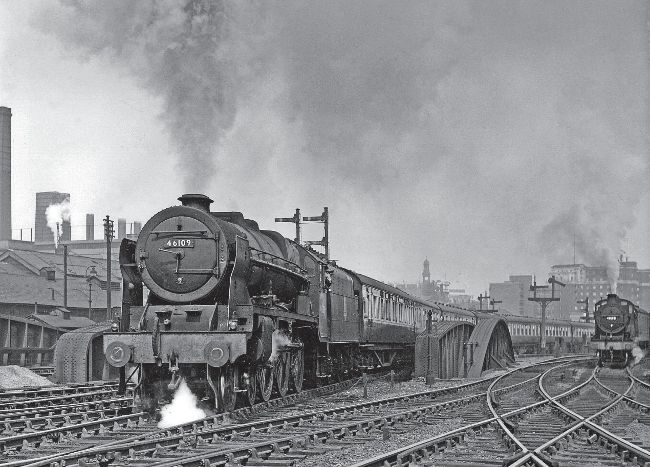
LMS ‘Royal Scot’ No. 46109 Royal Engineer negotiates Leeds City Junction as it departs Wellington station (Leeds City North) with the down ‘Thames-Clyde Express’ in the 1950s – the same loco that worked into Leeds with the Up Glasgow sleeper in Noel Proudlock’s survey. The train has just crossed over the Leeds & Liverpool Canal, with the signalbox just out of shot on the left. The lines on the right are those from New station (Leeds City South).
ERIC TREACY
THE fog was so thick outside Leeds City Junction signalbox, it was impossible to see what moves were taking place except by observing the operation of the track circuits shown on the large diagram above the lever frame.
Noel Proudlock, still in his teens, had been seconded on behalf of the District Office for four nights in February 1952, to record all train movements in and out of Leeds Wellington station. The first two nights had been foggy, but on the third it was impossible even to see which locomotive was moving where, let alone record its number. Luckily on the fourth night, February 28/29, it was clear enough to record the following account.
Signalman Perkins was working the night shift single-handedly, as booked, in contrast to the double-manned day turns. Modern observers might be forgiven for thinking the workload would have been correspondingly reduced, but that was far from the case at this complicated location. Moves across the western throat of Leeds City conflicted with access and egress from the former Midland Leeds Wellington terminus – the latter having been extensively rebuilt in the 1930s with a remarkable Art Deco concourse that remains to be admired even today (even if this temple has now become a den of fast food outlets). By 1952, Leeds Wellington had become better known to railway operators as Leeds City North, with the North Eastern section, that had sported its Leeds ‘New’ soubriquet since its 1869 rebuilding, was known as Leeds City South. Services on former LNER and Lancashire & Yorkshire routes continued to use Leeds Central, a little further away down Wellington Street, until that station’s absorption by City in 1967. The state of confusion this created persists, with a well-known hotel chain and at least one charter train company erroneously calling the remaining main line station ‘Central’.
The task ahead
Far from being an easy few hours’ work, the night shift at Leeds City Junction required high levels of skill and concentration – even without the hindrance of fog off the adjacent River Aire and Leeds & Liverpool Canal mixing with factory smog. The chief task was to turn round the four principal Anglo-Scottish sleeping car trains that used the Settle & Carlisle Line (St Pancras to Glasgow/Edinburgh and vice versa) with the minimum of delay.
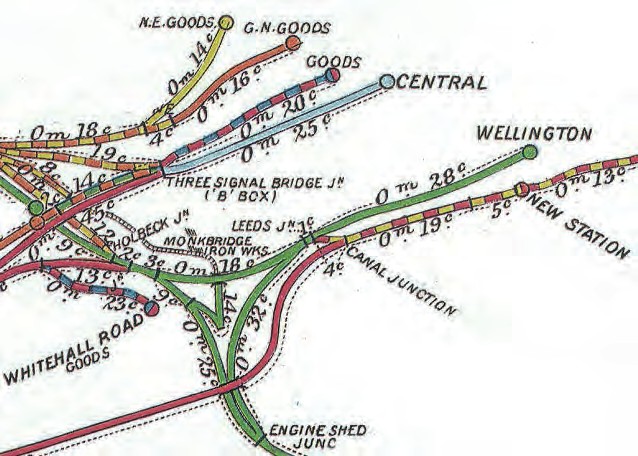
An extract from a Railway Clearing House map of central Leeds in the pre-Grouping era, showing the three main stations Central (GNR, L&Y, LNWR, NER joint), Wellington (Midland Railway) and New (LNWR, NER joint) plus various goods yards. Wellington and New became Leeds City North and South respectively in the late 1930s, while Central was closed in 1967.