MAKING MATTERS
Barking up the wrong tree
Points of interest to violin and bow makers
A case of mistaken identity left luthier Sibylle Ruppert with a batch of untested tulipwood – but a few experiments showed its high potential for instrument making
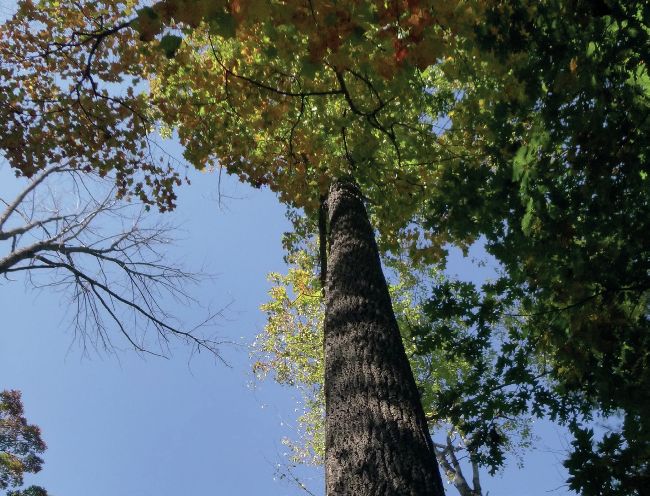
A 35-metre tulip tree in the Canadian part of the Carolinian Forest
JEAN-POL GRANDMONT
I n the late 1990s my husband Greg and I received a call from a wood dealer in southern Ontario. He excitedly told us that he had finally found a poplar tree large enough to be used for a number of cello backs. This was because, having moved from Europe to Canada in 1988, I missed the enveloping sound and cushioned response of a poplar back. We had already been looking for over a year, having heard there was a blight on the European black poplar (populus nigra) and large healthy trees were hard to find. There are a number of large native poplars in North America (such as trembling aspen, large-tooth aspen, balsam poplar and eastern cottonwood) that are common to our area, so when the dealer described it over the phone as a curly ‘yellow poplar’, we paid for it sight unseen.