Sharing the wisdom
Charlotte Gardner speaks to leading string players who have learnt valuable lessons from their colleagues and contemporaries, demonstrating that such insights are not only passed from teacher to pupil
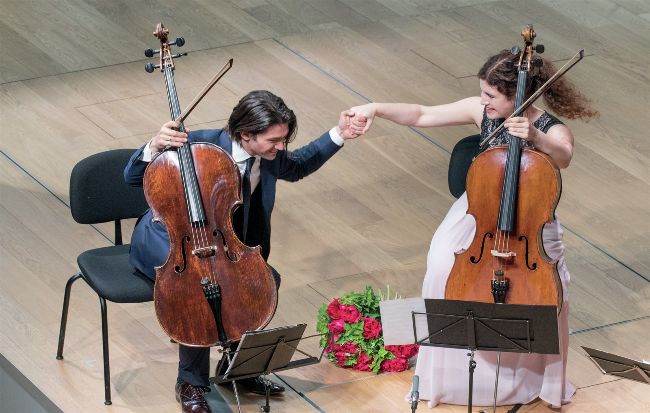
Gautier Capuçon and Julia Hagen at the Louis Vuitton Foundation
CELLISTS PHOTO FONDATION LOUIS VUITTON/MARTIN ARGYROGLO. DUSINBERRE PHOTO WOLFGANG SCHMIDT
Every day’s a school day, goes the adage. One of the most intriguing things about the world’s top string players is not only the degree to which they are all passionate eternal students, but how often they credit each other for practical insights into playing and the working practices by which they live their musical lives. Sometimes these insights come from teacher– pupil relationships, but just as often they stem from advice freely given between colleagues who actively delight in, draw upon and nurture each other’s excellence. Either way, this constant exchange of information, which takes place mostly under the public radar, is also a treasure-trove of knowledge for other performers – which is why it’s so valuable to ask musicians from various corners of the string-playing world to volunteer a favourite game-changing piece of knowledge they received from a colleague, and to find out how it came to be shared. Even more useful is the possibility of complementing this information with the advice-giver’s side of the story, which can result in the further perpetuation of some very useful tips, as well as offering a few behind-the-scenes snapshots of some of the personalities, human relationships and family trees of knowledge nourishing today’s musical landscape.
Ask the Takács Quartet’s first violinist Edward Dusinberre (right) to name a colleague who transformed his playing, and he cites Cleveland Quartet founding violinist Peter Salaff, thanks to precious interactions in the summer of 1998 when both musicians were teaching at California’s Music Academy of the West. ‘I got the quartet job young, aged 24 in 1993, so I had to do a lot of learning on the job,’ Dusinberre says. ‘By 1998, I still felt inexperienced as a quartet teacher, so when chatting socially with Peter one day and sensing what an encouraging person he is, I asked him whether he had any intonation-related tips or principles that he used when teaching quartets. He told me that when playing a major chord, it’s good to pitch the major 3rd on the lower side. And I thought, “If only I had known that in my first year with the Takács it would have been really helpful.”’ It wasn’t just that Dusinberre had been assuming that the major 3rd should be tuned a bit high; it was that his whole approach to tuning had hitherto been based on his perfect pitch. ‘I had stupidly prided myself on being able to play the note precisely where it should be,’ he explains, ‘but that’s very un-nuanced. His comment opened up a whole world for me of tuning according to a note’s function within a chord – because, of course, it changes very quickly: a note might be a major 3rd in one chord, then a tonic in the next. That’s a little bit scary, but also obviously much more interesting.’