Reviews
Your monthly critical round-up of performances, recordings and publicationsl
Berlin
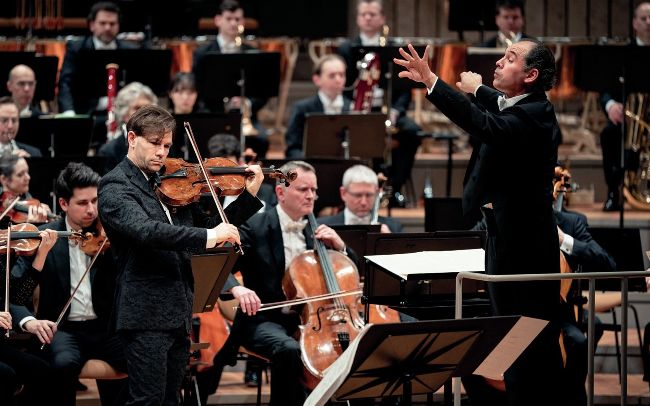
Amihai Grosz is part soloist, part Berlin Phil colleague in a new viola concerto
LENA LAINE
CONCERTS
AMIHAI GROSZ (VIOLA) BERLIN PHILHARMONIC/TUGAN SOKHIEV PHILHARMONIE 10 JANUARY 2025
Another month, another viola concerto world premiere! Four weeks after Mark Simpson’s (reviewed in March), the Philharmonie hosted the first performances of Donghoon Shin’s Threadsuns (also The Strad ’s Premiere of the Month in January). It takes its enigmatic title from a poem by Paul Celan which, including as it does words such as ‘song’, ‘singing’ and an intriguing ‘light’s sound’, seems to beg to be set to music. Shin has found for it a sound world he defines as ‘sad but not plaintive, lamenting but not wailing, despairing but not without hope’. His stated aim was to explore the piece’s dedicatee Amihai Grosz’s different personae as soloist, chamber musician and orchestral principal.
Accordingly, Threadsuns includes strikingly numerous passages in which the soloist duets with individual instruments or small groups, while the piece’s climax sees the viola as leader in a sweeping unison moment for the whole orchestra. A most sympathetic stage presence, Grosz stepped seamlessly in and out of his varying roles, interacting intimately with his Berlin Phil colleagues from every section, astutely adapting his timbre to each partner. He drew from his Gasparo da Salò viola a rounded, beautifully equalised sound from low C to the utmost heights, audibly relishing an idiomatically written, unashamedly melodious piece.
Under Tugan Sokhiev’s leadership, the Philharmonic framed the Shin premiere with excitingly three-dimensional readings of Lili Boulanger’s D’un matin de printemps and Mahler’s First Symphony, showing themselves in their strongest suit.
CARLOS MARÍA SOLARE
BERLIN RADIO SYMPHONY ORCHESTRA, RIAS CHAMBER CHOIR/VLADIMIR JUROWSKI PHILHARMONIE 27 JANUARY 2025
The Violins of Hope have often been featured in The Strad ’s pages: once owned by victims of the Holocaust, they were collected and lovingly restored by the late Israeli luthier Amnon Weinstein and his son Avshalom. On this, the 80th anniversary of the liberation of the Auschwitz concentration camp, they were played by members of the Berlin Radio Symphony Orchestra in a specially commissioned work by Berthold Tuercke, evocatively titled Aus Geigen Stimmen (roughly: ‘Voices from Violins’).
THIS MONTH’SRECOMMENDED RECORDINGS
Our pick of the new releases
Concertos of ice and warmth from Renaud Capuçon PAGE 86
Mature beyond his years: Daniil Bulayev PAGE 87
Personable Haydn from the Maxwell Quartet PAGE 89
To browse through more than a decade of The Strad ’s recording reviews, visit www.thestrad.com/reviews
In it 53 violins, a viola and a cello came successively to the fore, individually and in groups, while a chorus told their owners’ stories in English and Yiddish.
The musicians’ emotion at being able to play on these instruments was palpable: each of the short solos came from the heart. Poignantly illustrating each violin’s story, they were variously reminiscent of Klezmer or Romany bands, or of synagogal chant.
Tuercke’s 50-minute piece was framed by choral passages, their unconventional intervals fearlessly intoned by the RIAS Chamber Choir.
The other two pieces on the programme were the Partita for Strings (originally a string trio) by Gideon Klein, who perished in Auschwitz on the very day of its liberation, and Mieczysław Weinberg’s Fifth String Quartet, in a sophisticated, idiomatic arrangement for string orchestra by Vladimir Jurowski and Steffen Georgi. Performed by a full complement of strings under Jurowski’s fiery leadership, both pieces packed a tremendous punch. This was not a concert to be reviewed in the conventional sense: I left the hall feeling thankful for having been a part of it.
CARLOS MARÍA SOLARE
Philadelphia
MELISSA WHITE (VIOLIN) PALLAVI MAHIDHARA (PIANO) AMERICAN PHILOSOPHICAL SOCIETY 14 JANUARY 2025
DARIO ACOSTA
In this wide-ranging recital, violinist Melissa White and pianist Pallavi Mahidhara created magic with an easy-going naturalness – often addressing the large audience with comments about the composers. Sometimes these prefaces can overwhelm the content, but these two found the right balance.
Arvo Pärt’s ever-glistening Fratres opened the evening, immediately showing off the tone of White’s instrument (c.1780) made by Ferdinando Gagliano, yet with appropriate fragility. She then broadened her sound considerably for a sweeping reading of the Brahms Third Violin Sonata.
As I wrote in the August 2024 issue, Amy Beach deserves a bigger spotlight, and her Romance (1893) is yet another gem which White showed should be in the fingers of every violinist. One hundred and twenty years later, Jhula Jhule (2013) by Reena Esmail is a similar jewel, inspired by two Indian folk songs sung by the composer’s grandparents. White and Mahidhara offered Esmail’s valentine with irresistible tenderness, followed by stirring arrangements from Porgy and Bess by the great Jascha Heifetz.
But the real coup was saved for the finale: William Grant Still’s 1943 Suite for violin and piano, inspired by three sculptures from the Harlem Renaissance. In three movements – a bluesy dance, a lullaby and an animated finale titled ‘Gamin’ – White and Mahidhara offered the audience a metaphorical champagne flute, overflowing with jazz.
BRUCE HODGES
CAROLIN WIDMANN (VIOLIN) PHILADELPHIA ORCHESTRA/RAFAEL PAYARE MARIAN ANDERSON HALL 25 JANUARY 2025
For her debut with the Philadelphia Orchestra, violinist Carolin Widmann chose a striking calling card, Kaija Saariaho’s Graal théâtre (1995), originally written for Gidon Kremer, and inspired by Jacques Roubaud’s book about the legend of King Arthur. As a melancholy aside, Roubaud died scarcely a month earlier, in December 2024 at the age of 92.
Filled with arpeggiated double-stops, glissandos and harmonics, the two-movement work is unusual among the composer’s output in requiring no electronics. However, Saariaho creates a wonderland without them, a glittering array of instrumental effects, such as a sequence in the first movement with violin, timpani and bells, which impressed with its spare delicacy. There were plenty of opportunities for virtuosity, too, and Widmann’s demeanour – with calm glances at conductor Rafael Payare – belied some of its rugged challenges.
At the end, when the opening harmonics returned, Widmann gave them the feel of a gentle memorial – a love letter to a brilliant composer who left us not even two years ago. When the cheers erupted, many in the crowd were standing.
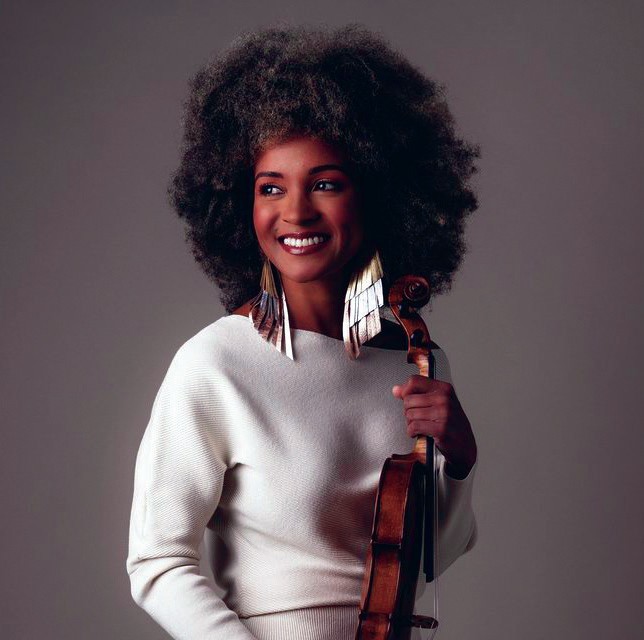
Melissa White: sparkling musicianship
www.thestrad.com
The evening had opened with the Suite no.2 from Ravel’s Daphnis et Chloé, with the Philadelphia strings on glistening form. After the interval, Tchaikovsky’s Sixth Symphony – admittedly a woodwind bonanza – was filled with more delectable string moments. Near the end of the riotous third movement, the double basses erupted with a shuddering barrage that, in another world, might have hurled the entire section off the stage.
BRUCE HODGES
SOOVIN KIM (VIOLIN) PAUL WATKINS (CELLO) GLORIA CHIEN (PIANO) RICARDO MORALES (CLARINET) PERELMAN THEATER 31 JANUARY 2025
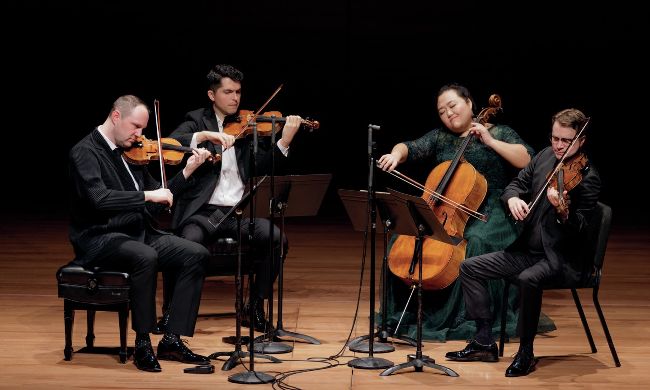
Letting Beethoven lead the way: the Calidore Quartet
TRISTAN COOK
To the traditional piano trio, add a clarinet, and voilà – Messiaen’s Quartet for the End of Time is born. It would be hard to ask for a better crew for this masterpiece than the foursome assembled here by the Philadelphia Chamber Music Society. Gloria Chien, Soovin Kim and Paul Watkins have aligned as the CKW Trio (the initials of their surnames), and were joined here by Ricardo Morales, principal clarinettist of the Philadelphia Orchestra.
The work’s eight movements not only showed off the group – especially in the more violent sequences – but the individual instruments as well. In the unison passages, there were times when Kim and Watkins’s tonal beauty joined as if they had plotted to fashion a slightly alien, hybrid instrument. In the fifth movement, Chien and Watkins offered patient, relentless control, coupled with sumptuous tone flooding out from the cellist’s instrument, made in Venice c.1730 by Domenico Montagnana and Matteo Gofriller. And in the finale, Chien again summoned the most gossamer of keyboard touches, alighting next to Kim, whose violin was constructed by the great Sam Zygmuntowicz. Needless to say, Morales made a dream partner.