SUNN O)))
MAXIMUM VOLUME YIELDS MAXIMUM RESULTS
Nearly 30 years into their career, the robed drone metal pioneers SUNN O))) have returned to their native Seattle to record a savage, elemental 10th studio album. Uncut joins Stephen O’Malley and Greg Anderson to learn about the birth of their uncompromising sound and their crossover from the world of extreme metal. “We’re the pilots,” they tell John Robinson. “The technical team get everything there without it catching on fire.”
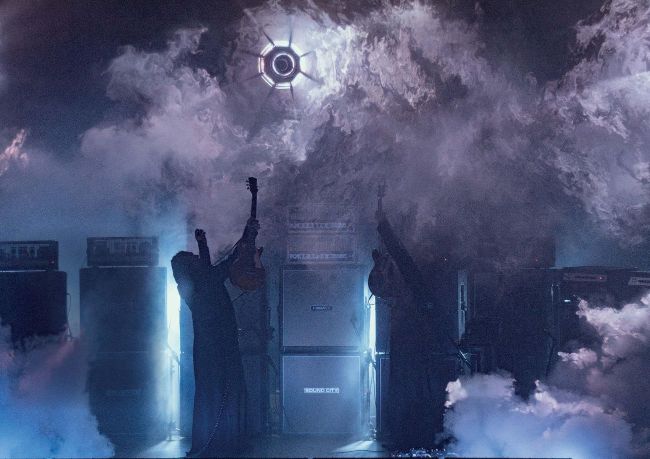
Dry ice in the house: Sunn O))) at the Lincoln Center, NYC, November 2024
Photo by LAWRENCE SUMULONG / © LINCOLN CENTER FOR THE PERFORMING ARTS
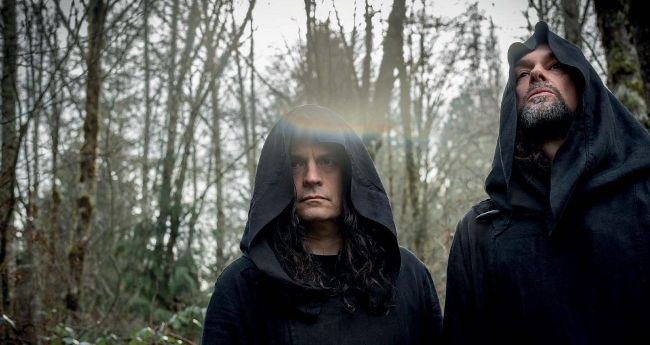
An abstract trip to parts unknown: O’Malley (left) and Anderson, 2025
CHARLES PETERSON
IT might be the extreme cold. It could be his associations with the influential music that has come from the area. Perhaps it’s the family ties he has here, and the memories, good and bad, of growing up in the region. But when Sunn O)))’s Greg Anderson gets off the plane from Los Angeles on arrival at SeaTac airport in the Pacific Northwest, he feels the same sensation every time. “It’s a heavy atmosphere,” he says.
Heavy, fortunately, suits Sunn O))) nicely. A band based around the guitars of Anderson (sometimes known as “The Lord”, born 1970) and Stephen O’Malley (aka “Soma”, born 1974), the duo have, for nearly 30 years, specialised in heaviness. From their origins in the stoner/doom metal scene of the mid-1990s, where they led, respectively, Goatsnake and Burning Witch, the pair have developed a signature sound based around dense, long-form riffing and tuned feedback. There are seldom vocals. There are hardly ever drums. If this outpouring of deep and physical sound has a wellspring, it would be in the early albums of Black Sabbath (an instructive Sunn O))) merch item is the “Praise Iommi” tote bag), but it has taken the group on a journey beyond genre. As they sound the depths and explore the potential of their riffs, at its best, Sunn O))) music becomes a journey beyond time.
As they have travelled, the gravity and originality of the pair’s music has attracted storied and varied collaborators (Julian Cope, Scott Walker), even as its saturated extremity has split opinion among metal connoisseurs. Some have spluttered, perhaps fearing being victims of a prank. Some, however, have fully bought in to the band, their iconography, their dry ice and their robes, to join an immersive mersive and abstract trip to parts unknown.n.
They have forged links with string orchestras in remote caves and with black metal vocalists in coffins. Their backline has been cast in salt and resin and displayed in a gallery after a concert that kept the audience outside. Their album covers have featured work by Banks Violette, Pieter Bruegel The Elder, Richard Serra and, most recently, Mark Rothko, whose work features on their new album.