FATHER MOTHER SISTER BROTHER Back in 2014, Jim Jarmusch told Uncut about his plan for what could have been his quintessential film. “John Lurie and Tom Waits were brothers who did not get along at all. Their father was a recluse, semi-alcoholic, but very intelligent; an interesting, gruff guy living out in nowhere, with a bottle and shotgun. I wanted the father to be Lee Marvin.”
The idea birthed a secret society – The Sons of Lee Marvin, comprising Waits and Lurie and sundry lost boys such as Nick Cave, Iggy Pop and Neil Young – but with Marvin himself long dead, the film remained a wistful pipe dream. For almost half a century, Jarmusch has investigated the many varieties of human loneliness, drifting through an oddball America of jailbirds, hobos, barflies, cab drivers, cowboys, vampires, samurai – and even, with 2019’s The Dead Don’t Die, zombies. You find fleeting couples and companions, but rarely a regular human family. Until now.
Father Mother Sister Brother is Jarmusch’s 14th feature and easily his quietest – the shift from flesh-eating undead to tinkling teacups could scarcely be more extreme. But in a way it’s a homecoming. In fact, you could argue that the family unit is the ultimate horror in the Jarmusch cinematic universe – the institution everyone is on the run from.
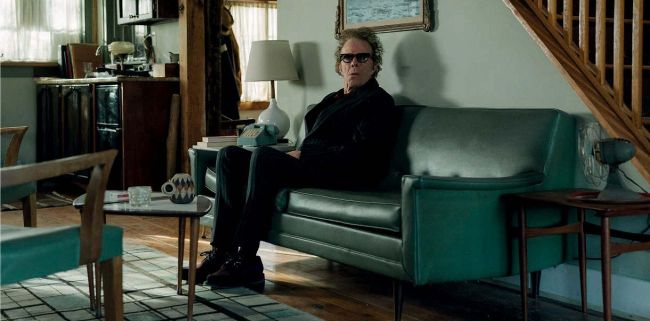
Making himself comfortable: Tom Waits in
Father Mother Sister Brother
He is, of course, an old hand at the anthology movie, and the film is formed of three distinct vignettes. A pair of awkward adult siblings (Adam Driver and Mayim Bialik) drive to see their father (Tom Waits) in snowy New Jersey. Two chalk-and-cheese sisters (Vicky Krieps and Cate Blanchett) pay a visit to their mother (Charlotte Rampling) in bourgeois Dublin. And, following the death of their parents, a pair of twins (Indya Moore and Luka Sabbat) pack up their old family apartment in autumnal Paris. The scenes feel like decaffeinated, smoke-free episodes from the Jarmusch deadpan coffeeshop universe.
Waits plays something like the Lee Marvin role in this scenario. As the wily widower in a New Jersey shack, he settles into the part like he’s easing into an old couch. It is the most overtly amusing segment, and the one that leaves you wanting to know more about the old devil’s carefully concealed wild side.
Meanwhile, in Dublin, Charlotte Rampling’s exacting novelist mother entertains her daughters in what is the nearest Jarmusch has ever come to a Mike Leigh film, emotions communicated entirely through forced pleasantries and loaded silences. Its pivot comes in a single line: Rampling reaching for the teapot and asking, with a surgical smile, “Shall I be mother?” The Parisian epilogue, which follows the twins clearing out their dead parents’ apartment, is warmer and quieter than its predecessors – almost a different film, shot by a different cinematographer (the first two segments use Frederick Elmes, the third Atsushi Nishijima).
There’s a mighty fine line between minimalism and inertia, and Jarmusch has walked it for his entire career. Father Mother Sister Brother won’t convert the doubters, and even admirers may find it a stopgap work. But for those who tune in to its elusive frequencies, the film’s formal rigour and warmth constitute a rare achievement – three moody jazz variations in a very minor key.
MIROIRS NO. 3 Though he began his career in the late 1990s as part of the Berliner Schule movement of politically engaged German directors, Christian Petzold’s films increasingly feel like fables or dark fairy tales. Undine (2020) was a version of the myth of a water nymph hoping to gain an immortal soul, updated to modern Berlin. Afire (2023) saw apocalyptic forest fires engulfing the summer dreams of an earnest young writer. Now, with Miroirs No. 3, he delivers an eerie story of mysterious doubles and broken families in the German countryside.
Once again his lead is the coolly enigmatic Paula Beer. Here she plays Laura (and the film draws consciously on every echo of that name through film history, from Hitchcock to Preminger and Lynch), a troubled Berlin music student and sole survivor of a car crash in the Brandenburg countryside. Miraculously unharmed, Laura is taken in by Betty, a middle-aged woman who lives alone in a charming but dilapidated old farmhouse. They strike an instant, uncanny chord of affection and Laura asks if she can stay for good. But as Betty’s errant, estranged husband and grownup son enter the picture, it becomes clear that the family are turning to the new arrival as a way of dealing with their own unaddressed traumas.
Though the film teases at ideas of grief and madness, those hoping for dramatic escalation may be disappointed. The plot revelations can be seen coming from some distance down the autobahn, and Petzold purposefully mutes any overly neat resolution. The director has said that the challenge for filmmakers today is to tell stories about a society that has given up on the future – characters whose only recourse is to make do and mend their broken circumstances. This is a modest addition to a great director’s filmography, but its modesty feels profound.
THE STRANGER François Ozon could be France’s answer to Richard Linklater – a director of indefatigable industry, ready to turn his hand to almost any genre in his quest to keep moving. Following his adventures in screwball comedy (The Crime Is Mine, 2023) and cosy crime (When Autumn Falls, 2024), he returns with a handsome adaptation of Albert Camus’ L’Étranger. Remarkably, considering the novel is a set text of earnest adolescence, it’s only the second adaptation since Visconti’s seldom-seen 1967 version starring a very sweaty Marcello Mastroianni.
Ozon’s decision to film in black and white was apparently a budgetary one, but it proves a winning strategy. Though filmed in modern Tunisia, cinematographer Manu Dacosse conjures a high-contrast 1930s Algeria shimmering with Bressonian radiance. It’s not an idle comparison: Ozon cast Benjamin Voisin, best known from his own Summer Of 85, as Meursault and had him read Bresson’s Notes On The Cinematographer – full of epigrams of actorly austerity – to prepare. Voisin carries the film through a quality of radical absence: his Meursault doesn’t explain himself, doesn’t seek sympathy, barely seems to register that anyone else is watching. It is a bold gamble that doesn’t entirely come off. Camus’ novel works because of Meursault’s narration, his voice performing the very indifference it describes. Here, Voisin’s handsome void is upstaged by the swaggering Pierre Lottin as Raymond the pimp, Swann Arlaud as the priest and, in particular, Denis Lavant – who has never met a scene he didn’t fancy stealing – as his dog-beating neighbour.
Ozon has added 21st-century touches, allowing the women and Algerian characters some depth and gently foreshadowing a post-colonial future – anti-occupation graffiti is glimpsed on the streets of Algiers, and Arab characters who remained ciphers in Camus’ text are given names and backstory. But this still feels like an overly polite rendition of a venerable classic that could have done with some of the wit and wildness he brought to his version of Peter von Kant.
ROSE OF NEVADA For more than 20 years, working with nonexistent budgets, 16mm Bolex cameras and hand-developed film, writer-editor-director-composer Mark Jenkin has documented a blasted, rusted, haunted corner of Cornwall as though mapping a lost continent. His 2019 breakthrough Bait felt like a film unearthed from some old, abandoned tin mine; Enys Men (2023) was as eerie as a public information film directed by Nic Roeg. Now, Rose Of Nevada feels like a first attempt to bring his very local, artisanal vision to a wider audience.
The film opens amid flotsam and jetsam, barnacles, seaweed, shards of rusting metal and yards of torn nylon netting – degraded relics of the once-thriving Cornish fishing industry – before focusing on the arrival in harbour of the trawler Rose of Nevada, missing for 30 years. Two men join the crew of salty old seadog Captain Murgey: Nick, desperate to provide for his young family; and Liam, a drifter eager to escape his past. After a night away and a rapid induction to gutting sardines from “head to arsehole”, they return to shore to find that everything has changed.
The decaying pub is now thriving with scallies in Ian Brown T-shirts, the jukebox is playing baggy fellow-travellers New Fast Automatic Daffodils, and the local food bank is now a busy supermarket. It turns out they have somehow returned to 1993 – three years before Nick was born. Unlike the accommodating Liam, who blithely accepts the new girlfriend and child he’s been returned to, Nick is terrified, and the film’s second half tracks his mounting, unanswerable anxiety.
It’s Jenkin’s first brush with commercial casting, pairing George MacKay (1917, The Beast) with Bond candidate Callum Turner, but it’s Francis Magee – once a fisherman himself – as the grizzled skipper Murgey who steals the film. If Enys Men flirted with folk horror, Rose Of Nevada is more of a moodily suggestive old sailor’s yarn. But if you are willing to let the salt, grit and spray of Jenkin’s film seep into your bones, this is his most disquieting work yet.
DJ AHMET In 1988, New Order saw fit to fade out their Balearic anthem “Fine Time” with the sound of a lamb bleating plaintively over the sequencers. This was doubtless a reference to their own sheep-like boarding of the acid house gravy train, rather than to the lambs dotting the Ibizan hillsides, but you might be reminded of it watching the delightful breakout film from Macedonian director Georgi M Unkovski – in particular the scene where his eponymous teenage shepherd investigates strange noises in the woods, stumbles on a rave, loses his flock and inadvertently becomes North Macedonia’s first TikTok star.
The scene is key to Unkovski’s Sundance award-winning film, which is concerned with the yawning generation gaps opening up in the country’s Muslim Yuruk community. The grandparents seem like they are slowly emerging from the nomadic 14th century, while their grandkids, hooked to their iPhones, are racing headlong into the 21st. Ahmet lives on a hillside farm with his dad and his little brother Naim, who hasn’t spoken since their mother died. His encounter with the forest rave, specifically the teenage dancer Aya from the neighbouring farm, steels his determination to play music – and soon, in defiance of all paternal warnings, he has his tractor rigged up with a homemade sound system.
To be sure, this is no Kusturican revelation. The script hits its beats with the precision of an 808, and occasionally with similar predictability – you might be put in mind of Footloose, but with more muezzin wails. But in his young lead Arif Jakup, Unkovski has discovered a diamond, and cinematographer Naum Doksevski bathes the whole enterprise in an irresistible golden light.
STEPHEN TROUSSÉ
REVIEWED THIS MONTH
FATHER MOTHER SISTER BROTHER
ATSUSHI NISHIJIMA
Directed by Jim Jarmusch Starring Tom Waits, Adam Driver, Cate Blanchett, Charlotte Rampling, Vicky Krieps Certificate To be confirmed Opens April 10
7/10
MIROIRS NO. 3
Directed by Christian Petzold Starring Paula Beer, Matthias Brandt, Barbara Auer, Enno Trebs Certificate To be confirmed Opens April 17
8/10
THE STRANGER
Directed by François Ozon Starring Benjamin Voisin, Rebecca Marder, Pierre Lottin, Denis Lavant Certificate 15 Opens
April 10
7/10
ROSE OF NEVADA
Directed by Mark Jenkin Starring George MacKay, Callum Turner, Rosalind Eleazar, Francis Magee Certificate To be confirmed Opens April 24
7/10
DJ AHMET
Directed by Georgi M Unkovski Starring Arif Jakup, Agush Agushev, Dora Akan Zlatanova Certificate To be confirmed Opens March 27
8/10