ASSISTED RUNNING
Many people face huge physical barriers before they can run. Whether you’re a disabled runner or someone who’s keen to help, here are ways we can work together to make running more accessible and inclusive
Words: Tina Chantrey
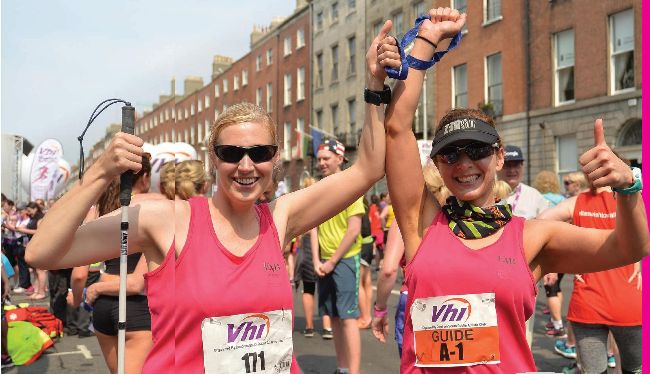
First place visually impaired runner Sinead Kane, left, with her guide Sinead Desmond after completing the 2016 Vhi Women’s Mini Marathon in Dublin
© CODY GLENN/SPORTSFILE VIA GETTY IMAGES
Taking part in any sport and experiencing the thrill of racing gives such a spectrum of benefits, especially for your mental health. The diversity of running is its true gift as it offers something to all people. It’s the greatest leveller. When you run with others, differences in age, ability, demographic, education and career all become irrelevant. And, whether you have a disability or not, when it comes to a race everyone runs the same distance. This makes the sport of running an inclusive and exciting opportunity for disabled runners to get active and have fun.
Disability can be incredibly diverse in the ways it can impair or limit activities in different areas of life, from a learning disability to mental health problems, spinal cord injuries, limb amputations, visual impairment, deafness or another impairment. The majority of impairments – physical or mental – aren’t visible. Less than eight per cent of disabled people use wheelchairs. Every runner will have their unique motives, needs and aspirations.
Getting started
The first step of setting a goal will give you the motivation to train when factors out of your control – such as the weather – throw you offtrack .With assisted racing, just as in other racing, ensure your first goals are realistic and achievable. If your aim is a local parkrun, do you have enough time to train to run 5K by your goal date? If you are aiming for a longer race, work back from race day and ensure you have enough weeks to build endurance, or time on feet, as well as strength through speed work and cross-training.
Most areas have a parkrun and these events are great for experiencing something like the feel of an organised race. At a parkrun, you aren’t under pressure to complete the whole distance until you’re ready, and you can slowly build week on week until you can achieve 5K. The ethos is non-competitive running for all and the community side of parkrun can help relax you into participating in sport regularly.
“We strive to be as inclusive and diverse as possible,” Kirsty Woodbridge from parkrun told WR, “and welcome those from all backgrounds, of any ability or age, to our free community events around the world.
“People take part in wheelchairs, with running frames and, if visually impaired, with a guide,” she says. “We would encourage anyone interested in taking part in parkrun to have a look at our website, read about the wide range of people who take part, get information about what to expect at an event, and reach out to the local event team with any further questions.”