THE PC TECH GRAVEYARD
PC history has many dead ends, but buried in that graveyard is an enormous amount of innovation and potential. John Knight examines what we lost along the way, and see what lessons might be able to help predict the future. Let’s start with operating systems
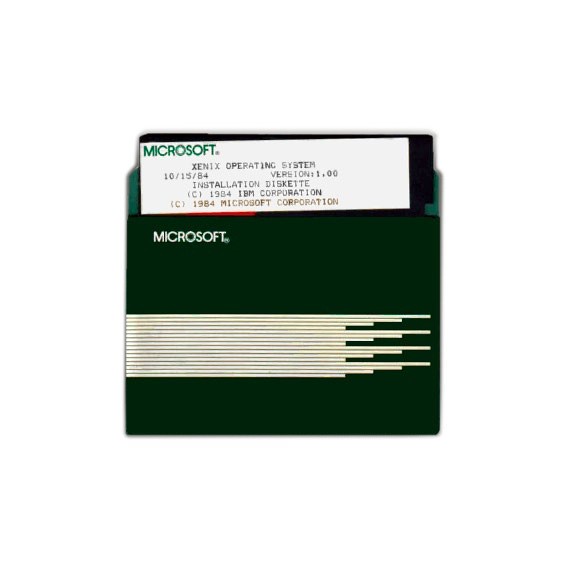
Compared to MS-DOS, or even Windows well into the ’90s, XENIX was a behemoth. A review copy consisted of 19 floppy disks.
© E+/GETTY IMAGES/FERRANTRAITE
MICROSOFT XENIX
Although it’s largely forgotten now, there was a time when Microsoft was betting big on Unix, both in business and the home. As the retail computing world moved from 8 to 16-bit, Microsoft analyzed the choice of operating systems, and expected Unix to eventually become the dominant platform.
Microsoft bought a license from AT&T in 1979, and announced its product for 16-bit microcomputers in August 1980.
Dubbed XENIX, the corporate giant had advertised their Unix variant as ‘the Microcomputer Operating System of the Future’. Instead of selling straight to customers, Microsoft used existing software vendors as middlemen, particularly The Santa Cruz Operation, or ‘SCO’, in which Microsoft bought a controlling share.
SCO had already been selling, porting, and consulting on Unix products, so it made sense to leave the difficult legwork to Santa Cruz.
On release, a complete SCO XENIX set cost $1,350, while a barebones system was $595. XENIX required at least a PC-XT with a hard disk and 256KB of RAM, although 512KB was recommended.
XENIX was a proper multi-user, multi-tasking operating system when DOS could only do one thing at a time, and any appearance of multi-tasking by Macs was smoke and mirrors.
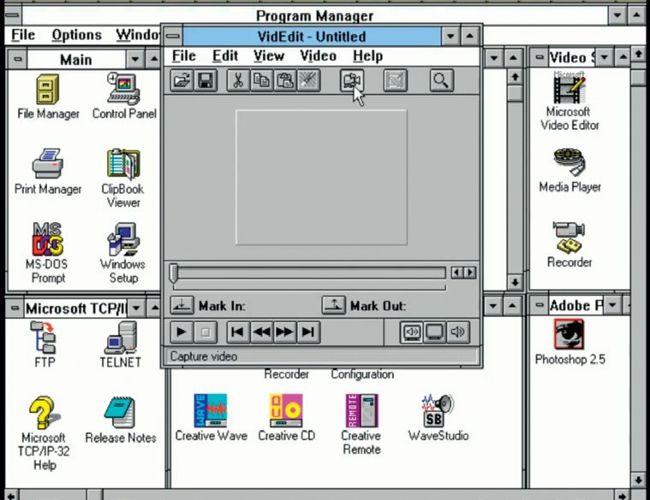
The Windows 3.x series was far from perfect, but it was good enough for most people, and timing is everything.
© CREATIVE COMMONS/WIKIPEDIA
Other users could access the system via the serial port, turning it into a ‘microframe’, and ten different people could switch between their own ‘virtual consoles’’ via a simple key combination—a feature still used today.
Although XENIX was targeted at multiple architectures, such as the Motorola 68000, Zilog Z8000, and PDP-11 server platform, it was really the IBM PC compatible where XENIX found its biggest user base.
When IBM released its new 286-based AT platform, XENIX really came into its own. This new off-the-shelf hardware standard allowed for much greater RAM and hard drive capacity, which was critical for running a good server.
For around $5,000, anyone could buy a top-spec AT with a big hard drive, making it an instant hit among universities and early ISPs, with XENIX being a natural fit for the task.
At the end of the decade, XENIX had become the most widely used version of Unix. However, as the PC platform moved to 32-bit, competition grew. Of particular note were Digital Research Inc’s Unix System V (owned by AT&T), and IBM’s own variant, PC/IX.
Microsoft didn’t want to compete with such established corporate giants, and decided to end its involvement in Unix. Ownership of XENIX was transferred to SCO in 1987, although Microsoft retained its stake in the company.
Uptake of Unix never really went beyond the corporate and scientific world, and the home user adoption Microsoft had predicted never happened—DOS was good enough for Joe Average. Microsoft entered into a short-lived alliance with IBM, working on OS/2, before focusing on their own NT architecture.
IBM OS/2
OS/2 was initially a joint project between IBM and Microsoft, intended to replace DOS. The naming scheme was based on IBM’s second generation of PCs, the ‘Personal System/2’ (PS/2) line. IBM and Microsoft entered a joint development agreement in August 1985, before releasing OS/2 1.0 in December 1987.
OS/2 1.0 was only a text-based ‘semi-GUI’ affair, but had advanced features such as multitasking, a ‘Protected Mode’ for better stability, and an enhanced memory manager, allowing OS/2 to make use of the much greater RAM capacity available to 286 and 386 processors.
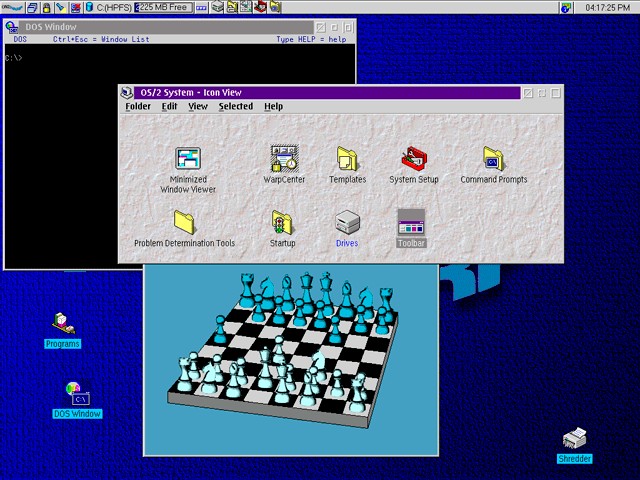
The OS/2 1.3 desktop looks extremely similar to the Microsoft Windows 3.0 desktop that was soon to come.
In October 1988, OS/2 1.1 was released. Its chief feature was a graphical desktop, which was extremely similar to Windows 2.0. This allowed multi-tasking to be done graphically, instead of using the text-based Program Selector of 1.0.