ON SHED
Maintaining interest
Gareth Evans visits Didcot Railway Centre and learns about the latest motive power developments at the Oxfordshire home of the Great Western Society.
ENTERING Didcot Railway Centre is a step back in time – an oasis of Western Region heritage surrounded by a busy triangle of main line passenger and freight traffic to Paddington, Oxford, the West of England and South Wales.
The former steam shed serves as the headquarters of the Great Western Society (GWS) and is home to an invaluable collection of buildings, rolling stock, infrastructure and artefacts.
Preserving the past can also mean keeping up with the present. A new, fully accessible pedestrian entrance is under construction (RM May) and following the restoration of the coal stage, the engine shed is due be sensitively restored.
There is an awareness that the operation has to be commercially sustainable while maintaining interest and not dumbing down the offering.
On the day of my visit – Saturday, April 13 – it was an ‘off-peak’ diesel day, with both the Class 14 and 31 in operation. The centre was bustling with families. It’s easy to forget the vastness of the site and quite how much there is to see and experience.
While some enthusiasts may be more selective about visiting when their favourite loco is in operation, a regular member of the public may appreciate a train ride in one of the finely restored vintage carriages. As a result, there is a role for smaller steam locos (which are more economical to use) as well as diesels; both of which help to keep the costs of operation in check while still providing interest and value for money for visitors. Larger locos continue to operate on key days.
The engine shed and part of the loco workshop are open to the public, but for safety reasons, a lot goes on out of the public gaze – so it was time for The RM to find out the latest developments.
Steam loco strategy
In terms of deciding which locos will return to steam, locomotive manager Leigh Drew outlined some of the considerations: “I never say never for any of them, but it’s all money and workshop capacity. I know a ‘Hall’ is different to a ‘Saint’, but while we’ve got the ‘Saint’ running, do we need a ‘Hall’ in traffic?
“The ‘Hall’, ‘Saint’ and ‘38XX’ have the same boiler size – they all take about the same amount of coal and water to run. The enthusiastic part of me would love to see as many as possible of them in action – but clearly, we have to be realistic.
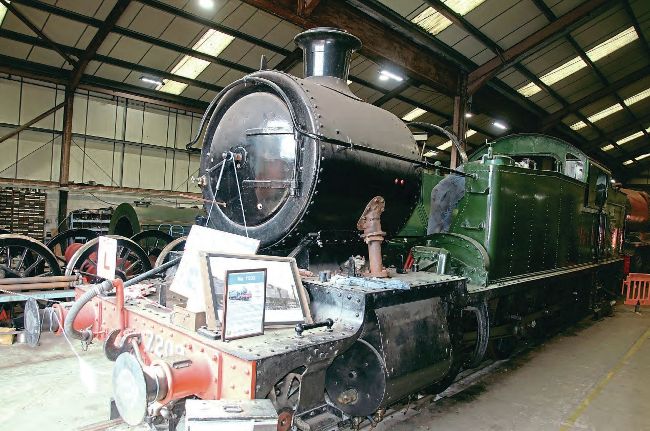
The restoration of GWR 2-8-2T No. 7202 from Barry scrapyard condition continues to progress inside the workshop. Just visible on the left are the retyred wheels for 0-6-0PT No. 3650.
ALL PHOTOS TAKEN ON APRIL 13 BY GARETH EVANS
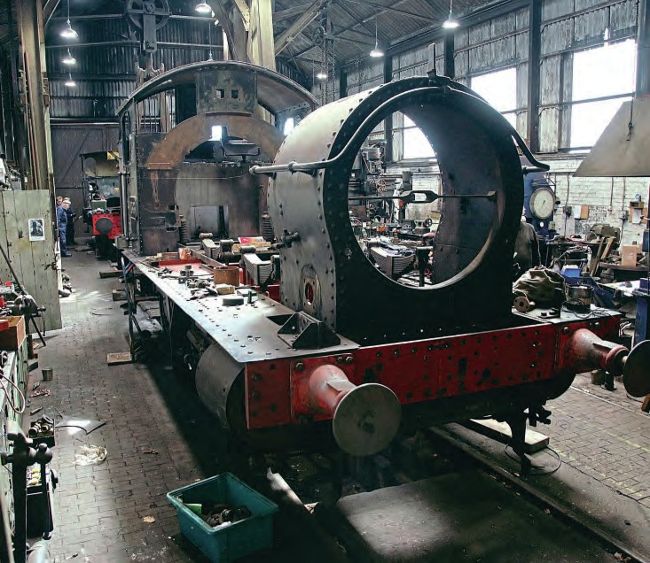
GWR 0-6-0ST No. 1363, the sole survivor of the 1361 Class, is being returned to traffic.
“The last two large components for No. 1363 are the boiler and tank. I’m not going to put a date on it, but hopefully it won’t be too much longer”
“You could say the same about Large Prairies Nos. 4144 and 6106. With No. 4144 in ticket and in good condition, do we need two of them at the same time? That’s not to say No. 6106 will never steam.
“Everything here has run at some point – No. 5900 Hinderton Hall and No. 6697 not that much, for example, but all have steamed. No. 6697 is in the same category as Nos. 4144 and 6106 in terms of boiler size.”