L I V E
LAMBCHOP
Barbican, London, June 1
Backed by piano, bass and choir, Kurt Wagner rewrites The Bible
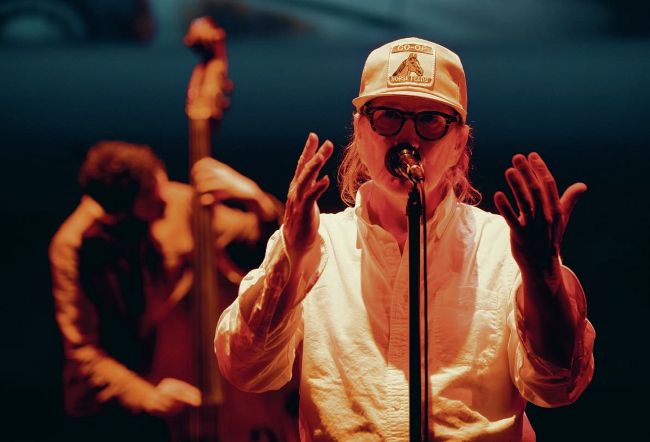
Hermeticyet open-hearted: KurtWagner frontsLambchop
ERIKWESTRA
THIS is Lambchop’s first London visit in five years, and they take no prisoners. Seven songs from most recent album The Bible are interspersed with seven from throughout their career, in arrangements determined by a trio format faintly resembling the band’s scuffling Nashville beginnings – Kurt Wagner on vocals, Andrew Barber on piano and Cole Davis on double bass – plus a six-piece choir directed by Blake Morgan. The soundworld, much reduced from The Bible’s spare but richly conceived palette, is rigorously fixed.
Wagner has been stripping back and reconfiguring Lambchop ever since Nixon’s relatively maximalist, soul-powered success 24 years ago, gradually abandoning the band in favour of a more amorphous backdrop for his songs. Lately, even his voice has been interrogated by Auto-Tune. At the same time, his oblique but emotional lyrics have emphasised married love, physical infirmity and his country’s similarly fragile democracy. Dipping into history and literature, they explore a landscape centred on Wagner’s Nashville porch and its environs, an intimately specific yet far-reaching Americana mostly detached from the alt.country stylings of the genre Lambchop helped to disseminate. You could draw comparisons with Jeff Tweedy, especially minus Wilco, but there’s little else quite like this hermetic yet open-hearted lifetime project.
The Bible’s orchestral prelude is emulated tonight by the choir’s lilting, heavenward harmonies. Wagner strolls to the mic, hands stuffed in pockets, and stands spotlit like Sinatra under a fog-shrouded ’50s streetlamp. This modest man’s face stays in impenetrable shadow for the next 90 minutes, his familiar workingman’s hat and his trainers’ white soles the only bright spots. Masked by darkness, he is an anonymous crooner, vanishing into songs which, visually stripped of their source, seem to float austerely as pure music. Dylan’s sometimes perverse stagecraft comes to mind.
“His Song Is Sung” establishes The Bible’s emotional terrain. Though set in a study, it could be a hospital ward blues, concerned with evaporating time, unmoored feelings and forgetting. “And I smell the age on your right hand”, Wagner sings, the choir rising like birdsong with him. “So There” follows, suggesting his hope for the world: “To be civil, to be gentle/To be honest, to be kind/To welcome the unexpected/With an unsatisfied mind”.
Bass and piano swirl, the latter cradling Wagner’s lilt on the enigmatic, haikulike “Dylan At The Mousetrap”. The choir carry his gravelled, imperfect high notes as he throws his head back and moans: “I can’t forget things any more”. “Daisy” then offers the latest album’s sentiments at their most beautiful, as he outlines an absolute love’s terms at its ending: “All I had now once is true/All I had now once is you”. Wounds and wonder are intertwined.
SETLIST
1 His Song Is Sung
2 So There
3 Dylan At The Mousetrap
4 Give It/Once In A Lifetime
5 Daisy
6 AMajorMinor Drag
7 A Chef’s Kiss
8 TheNew Cobweb Summer
9 Listening(To LambchopBy MyselfAgain)
10 That’sMusic
11 TheManWho LovedBeer
12 UpWithPeople
13 PoliceDog Blues
ENCORE
14 Theöne
Songs flow one to the next, forbidding applause, while the often doowop-style choir becomes a mixed, sometimes prissy blessing. And yet Nixon anthem “Up With People” builds up steam, finding tensile soul attitude over the bass’s tom-tom-like tattoo. “The New Cobweb Summer” rises forcefully on choral swells, and a cover of Sun June’s “Listening To Lambchop (By Myself Again)” makes Lambchop’s own political edge explicit, castigating “some Republican shit”, and declaring, “They don’t care about us”. The Bible’s “That’s Music” is Wagner’s manifesto, a “ballad of a country music nerd” in which 1968 Olympics Black Power protester Tommie Smith joins the Opry, and an unnamed innocent chokes to death. “We can resist”, he quietly insists. “That’s music”. Wagner digs back to 1996’s How I Quit Smoking for encore “Theöne”, which among other things describes two lovers’ modest walk home, his voice and words hitting as powerfully as they have all night. Then he skips across the spotlight, dodging the acclaim like bullets as he goes.
NICK HASTED