SUSS
Birds & Beasts NORTHERN SPY 8/10
Veteran instrumentalists traverse dusky, barren landscapes on a definitive fifth album.
By Wyndham Wallace
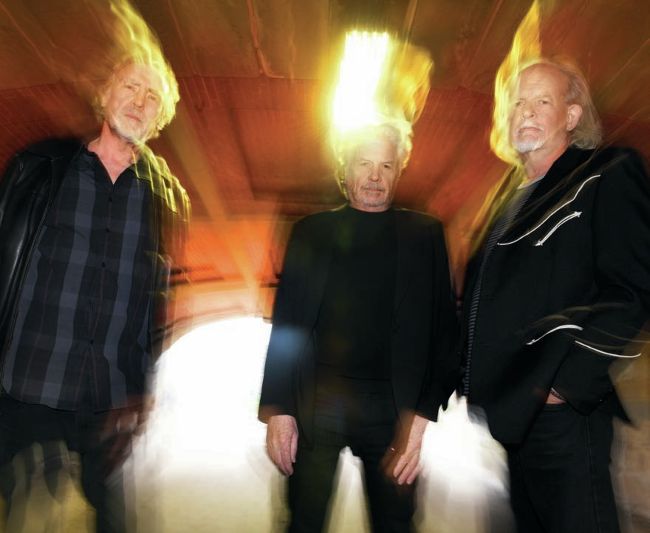
Mirage men: (l–r)Jonathan Gregg, Pat Irwin and Bob Holmes of SUSS
WHEN Uncut launched an ‘Ambient Americana’ edition of our long-running Sounds Of The New West CD series three years ago, it was natural that SUSS should provide the opening track.
Qualities shared with the panoply of like-minded practitioners on the disc include a preference for somnolent, meditative tempos verging on the New Age, and spectral yet luxurious washes of pedal steel. “Drift” was not only suitably titled as an indication of the New Yorkers’ aesthetic, but stood – or more likely reclined – as a perfect introduction to a widescreen instrumental style whose star was very much in the ascendant.
While not necessarily a self-defined scene, ‘Ambient Americana’ felt like a natural, starlit canopy beneath which the likes of William Tyler, Andrew Tuttle (a recent SUSS collaborator), Steve Gunn, Luke Schneider and Mary Lattimore might quietly rest. Yet the genre was far from a new conceit. Indeed, its most obvious roots lie in Brian Eno’s Apollo: Atmospheres & Soundtracks, released in 1983. Daniel Lanois’ voluminous production may have been intended to evoke endless space, but it works just as well looking towards the earth’s horizons as down upon them.
Apollo definitely provides a template for SUSS’s desert hallucinations. Indeed, given that “Drift” shares its name with a similarly boundless track written for that collection by Eno’s brother Roger, it may have been titled in tribute. Just compare the unforgettable “Deep Blue Sky” (also written with Roger alongside Lanois, who provides its distinctively glimmering pedal steel melody) with Birds & Beasts’ “Flight”, where Pat Irwin’s EBowed guitar traces a similarly poignant theme in a style less lethargic than carefree.
SLEEVE NOTES
1 Birds
2 Restless
3 Overstory
4 Flight
5 Prey
6 Beasts
7 Migration
Produced by: SUSS
Recorded at: Pat Irwin’s studio in Long Island City
Personnel: Bob Holmes (acoustic guitar, mandolin, violin, keyboards, harmonica, loops), Pat Irwin (guitars, EBow, bass, keyboards, piano, loops, additional pedal steel on “Beasts”), Jonathan Gregg (pedal steel), Gary Leib (synths, loops, good vibes on “Migrations”)
Birds & Beasts seems to acknowledge Eno’s long shadow elsewhere, too. “Birds” mimics ideas of ‘generative composition’ first explored on 1975’s Discreet Music, its short phrases on acoustic guitar, pedal steel and synths drifting – that word again – in and out of focus. “Beasts”, as well, features a simple but familiar two-note progression, like a ghostly echo, half a century later, of Eno’s first ambient work.
Certainly SUSS’s hair is white enough to confirm they’re unquestionably familiar with both albums. Pianist and guitarist Pat Irwin emerged during the no wave era, later spending almost two decades with The B-52s. Keyboardist Bob Holmes played in ’80s country new wavers Rubber Rodeo, alongside SUSS co-founder Gary Leib, who died in 2021 (he nonetheless appears here, on the closing “Migrations”). Pedal steel player Jonathan Gregg, meanwhile, was part of The Mundanes, the early-’80s Rhode Island band whose number also included They Might Be Giants’ John Flansburgh and a future executive producer of Beavis And Butt-Head. These early ventures, it’s worth adding, offer few clues as to where SUSS have ended up over the course of five increasingly expansive albums, beginning with 2018’s Ghost Box.
Music this cinematic inevitably calls to mind another record released the same year as Apollo: Ry Cooder’s luminous Paris, Texas score. One can easily imagine Harry Dean Stanton stumbling across scorched earth to “Birds”, or perhaps “Prey”, although the latter’s title correctly hints it might better suit a more sinister night-time trek through uninhabited wilderness. Either way, Birds & Beasts is nothing if not vivid – a summoning of the mythical American landscapes that kept pilgrims heading west. ons”) Despite its antecedents, the album is rarely conventional. There are flashes amid the floating, shimmering “Restless” that recall Jim O’Rourke’s brilliantly sprawling Bad Timing, while the 10-minute “Migration”, with its mournful harmonica and disembodied voices, might have emerged had Feast Of Wire-era Calexico collaborated with TNT-era Tortoise. There’s little spaghetti western schtick, nor other theatrical if sometimes effective mannerisms. At times, Birds & Beasts feels most akin to The KLF’s Chill Out, shorn of signs of humanity.
None of these references undermine SUSS’s singularity and the hypnotic hold of their radiant mirages. The imagery may be familiar – indeed, few fit the ‘Ambient Americana’ description quite as neatly as SUSS – but it’s sufficiently refreshed to prevent mistaking these haunting trails for aimless cowboy clichés. Like the rocks, they endure. Like the imagination, they have few limits. More timeless than timeworn, then.
Q&A
As SUSS explain, it’s a vibe, not a travelogue…
You don’t live in the landscapes that your music evokes. Does that make it easier to be imaginative?
JONATHAN GREGG: Bob now lives in Florida, and Pat and I are scattered about. But our musical landscapes vary widely, and don’t depend on being in or depicting any particular place. BOB HOLMES: All three of us have done a lot of travelling. But the sound SUSS is known for – the American West or the wide-open spaces of the plains – is more an evocation of the styles of music people associate with those landscapes. Morricone did not live in the American Southwest. Sons Of The Pioneers did not live on a ranch. Bill Monroe did not live in Kentucky. And country music is rarely made any more by people who actually live in the country.
How does this represent a development from previous albums?
HOLMES: Birds & Beasts was the first created as a trio. We knew we’d be making a simpler record, so each part needed to be special. We weren’t afraid to include melody or rhythm when the song told us, and if a song wanted to be longer, then we listened. The tracks just seemed a bit more ‘human’ this time, and because being human these days has its pros and cons, we felt Birds & Beasts was a good title.
BOB KRASNER