A new Dorn’
In 2025 – 32 years after the Dornier 328 entered service – the Bavarian-built commuter will return as the reconsidered, redeveloped, revamped and re-engined D328eco. Andreas Spaeth talks to Deutsche Aircraft CEO Dave Jackson
German civil airliner production has a chequered history. The first post-war project was the East German Baade 152 quad-jet in the late 1950s – the Dresden-built airliner never advanced beyond prototype testing before being cancelled after a crash in March 1961 killing all four crew.
The first West German-built aircraft was the HFB 320 Hansa Jet –a business jet for up to 12 passengers.
A seven-year production run concluded in 1973 after 47 examples had been completed.
In the early 1970s, the VFW-Fokker 614 was an innovative 40-passenger regional jet design with two Rolls-Royce/SNECMA M45H turbofans mounted above the wings. It was both ahead of its time and a commercial flop. Only 19 were built. Three airlines operated it briefly and the last airworthy example, which flew for the Deutsches Zentrum für Luft- und Raumfahrt as a fly-by-wire test aircraft, was retired in December 2012.

Deutsche Aircraft also plans to optimise the D328eco for air ambulance, coast guard, freighter and military transport roles
DEUTSCHE AIRCRAFT
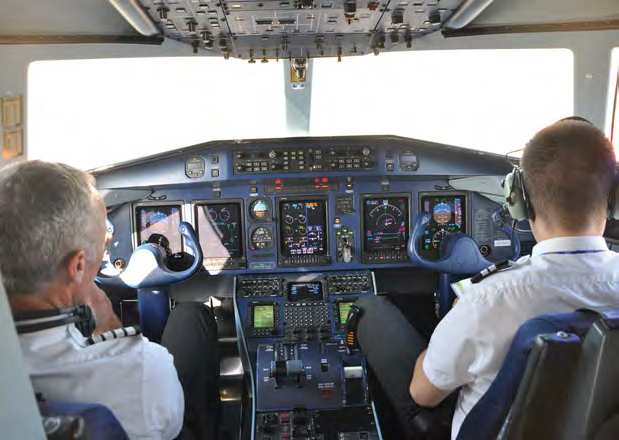
The Do 328 was hailed as being ahead of its time when it entered service, thanks to its use of composite materials and the inclusion of a glass cockpit
ANDREAS SPAETH
Bavarian beginnings
When the VFW 614 was conceived, German efforts in the airliner market started to be funnelled more and more into the fledgling Airbus project, of which Germany became a major partner early on.
While Airbus has flourished since the 1980s, any airliner development independent of the Pan-European aerospace giant became more and more difficult.
Dornier, a German aircraft manufacturer with a proud history stretching back to 1914, was somewhat of an outsider.
It had carved out a niche with its range of rugged, short take-off and landing (STOL) utility aircraft beginning with the Do 27 in 1955. The ’27 was later developed into the twin-engined Do 28 and, eventually, the 19-seat Do 228 commuter which first flew in 1981. Some 245 ‘two-two-eights’ were produced at Oberpfaffenhofen, Bavaria between 1982 and 1997, while Hindustan Aeronautics has built more than 125 examples under licence in India. The updated Do 228NG was launched by Swiss aerospace and Defence firm RUAG 2007 and is now under the control of US-based General Atomics.
As easy as 3-2-8
Dornier became a member of the Daimler-Benz group in the mid-1980s. Its last new offering, which built on the success of the 228, was the Do 328. Designed and built in Oberpfaffenhofen, the 30-seater turboprop was ahead of its time when entering service in 1993.
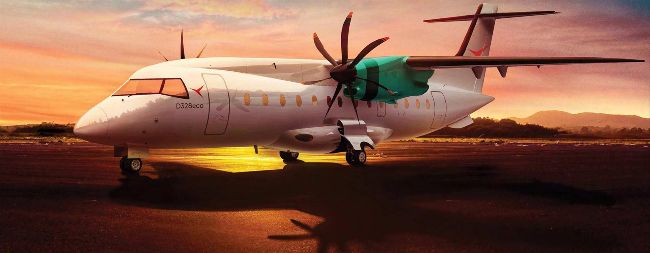
The D328eco will be 6ft 10in (2.1m) longer than the original Do 328
DEUTSCHE AIRCRAFT
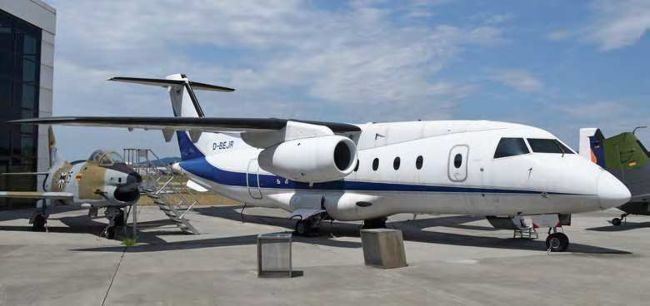
The third Do 328 prototype and the maiden 328JET, D-BEJR (c/n 3102), has been preserved at the Dornier Museum in Friedrichshafen, Germany
RICHARD VANDERVORD
As well as boasting a glass cockpit, it is almost as fast as a jet with a cruise speed of 345kts, and a quarter of its construction comprises composite materials. It also holds a rare distinction in aviation: it is the only passenger aircraft to offer two forms of propulsion – as either a turboprop or a jet.