NATURE
WE’RE ALL AFLUTTER
ls butterfly-spotting the new bird-watching? It certainly feels that way with the summer season in full swing - and our passion for these delicate beauties is driving Conservation initiatives too
by MIKE UNWIN
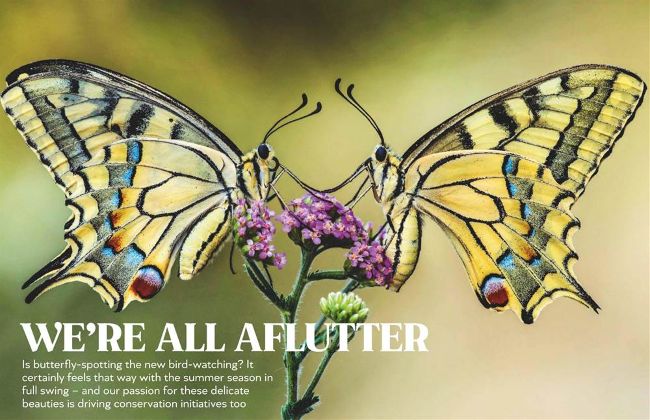
Mirror image Stunning swallowtail butterflies
Last September, I was taking a walk through my home city of Brighton, when I noticed half a dozen people crouched around a bush in a clearing beside some allotments.Some were sporting serious cameras, and all were focused on a small patch of knee-high undergrowth. What was going on?
The answer was long-tailed blue butterflies -a migratory species from the Mediterranean so rare in the UK that it doesn't even appear in many field guides. Edging closer, I followed the focus of the khaki-clad paparazzi and spied one of the insects perched on an everlasting pea plant. No bigger than a fivepence, the undersides of its closed wings were a marbled cappuccino-brown, quite distinct from the spots of the common blues I'm more familiar with. A burst of sunshine prompted it to open its wings, revealing beautiful violet upper-sides (proof that it's a male) and those tiny tails. It rotated slowly, triggering a fusillade of camera shutters -like a red-carpet celebrity milking the moment.
Today, butterflies are big news, attracting legions of enthusiasts who might once have expended their spotting energies on birds. Zoe Randle, senior surveys officer at Butterfly Conservation, a UK charity dedicated to protecting butterflies and moths, says butterfly watching has been taking off since the 2000s, accelerated by the pandemic. 'A lot of people took solace in butterflies during lockdown,' she says. 'We had time and space and peace on our minds.' And the beauty of butterflies is that they're everywhere, with each habitat -from the South Downs to the North York Moors -home to its own community of species.