MAY 2025 TAKE 338 1 LONNIE LISTON SMITH (P44) 2 JEFF BRIDGES (P46) 3 HENRY BADOWSKI (P47) 4 JULEE CRUISE (P48) REISSUES | COMPS | BOXSETS | LOST RECORDINGS
THE BLASTERS
An American Music Story: The Complete Studio Recordings 1979–1985 LIBERATION HALL
Six years of holy rock’n’roll racket.
By Allan Jones
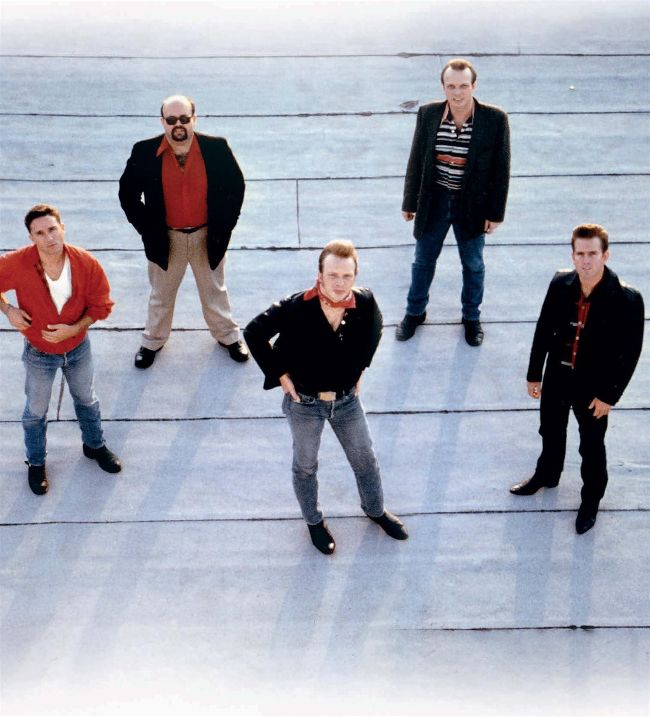
The Blasters in 1982: gleefully traversing the “depths and dimensions” of American music
GARY LEONARD
“It’s a howl from the desert, a scream from the slums”
TOWARDS the end of March 1982, Dave Alvin, sitting in fading Texas sunlight on the top steps of a fire escape running down the side of a club called The Fitzgerald in a north-western suburb of Houston, was talking about “American Music” – “It’s a howl from the desert, a scream from the slums/The Mississippi rollin’ to the beat of the drums” – a key song in The Blasters’ early repertoire; a battle cry, a call to arms. It was originally the title track of the debut album The Blasters cut in 1980 for Los Angeles rockabilly label Rollin’ Rock: 13 tracks, recorded over two days in someone’s garage. They re-recorded it for their eponymous second album, for LA independent label Slash, a record that back then in 1982 was in the US Top 40, a palpable hit.
“‘American Music’,” he said, “that’s got nothing to do with any kind of flag-waving bullshit. It’s about all the voices in the American choir.” This made him laugh out loud. “That sounds a bit fucking grand, but I can’t think of a better way to put it. There are so many depths and dimensions to American music.” He counted them off. Jazz, rock’n’roll, country, blues, rockabilly, R&B, soul, folk. “What a history,” he said.
REISSUE OF THE MONTH 9/10
“But, fuck, there are kids out there right now who think rock’n’roll started with REO Speedwagon and they’ve probably never heard of Elvis, let alone Big Joe Turner. But things are changing. They’ve got to.”
The insurgent version of “American Music” they play that unforgettable night at The Fitzgerald casts them as rowdy agents of that change, The Blasters part of a cabal of LA bands including X, Los Lobos, The Gun Club, Black Flag who do as much in their way as REM or anyone else to reclaim ’80s American rock from big-haired hard rock and metal bands, that spandex pantomime. It also seemed that night more than ever like an insurrectionary mission statement for the great noise The Blasters made across the four studio albums collected on this handsome boxset alongside a disc of previously unreleased recordings, mostly barnstorming studio outtakes, including “Kathleen”, one of their wildest, most fabulous recordings.
They formed in 1979, four music-mad friends from Downey, a blue-collar suburb of Los Angeles, the lineup that a year later recorded American Music consisting of Dave Alvin on lead guitar, his brother Phil on vocals and rhythm guitar, bassist John Bazz and drummer Bill Bateman. They played wildcat ’50s rock’n’roll, rockabilly, blues, old country tunes, an unfashionable mix for the time. The hip LA clubs wouldn’t book them, so they made their reputation in tougher places, hustling gigs at Mexican bars, playing for bikers, low-riders and assorted hoodlums.
Sibling revivalry: Dave and Phil Alvin front The Blasters
The album they made for Rollin’ Rock was pretty much what you might expect from a fearless young band whose only chance of making a record this might have been, the best of the tracks full of electrifying urgencies, The Blasters as ever making a holy rock’n’roll racket. There were early sketches of “American Music” and “Marie Marie”, two of seven group originals that included Dave’s “Flat Top Joint” that celebrated Gene Vincent, Jerry Lee Lewis, Lightnin’ Hopkins and Jimmy Reed. Elsewhere, they covered Bill Haley, Jimmie Rodgers, Billy Boy Arnold’s “I Wish You Would” (which The Yardbirds recorded as their first single) and tackled “Crazy Baby”, the B-side of a 1958 single by The Rockin’ R’s, with glorious ferality.
By the time they recorded their eponymous second album for Slash, The Blasters had been augmented by hilariously taciturn pianist Gene Taylor, whose ballistic style had been sharply honed by stints with Big Joe Turner, T-Bone Walker and Canned Heat. They also now had a horn section: a pre-Los Lobos Steve Berlin and legendary New Orleans sax player Lee Allen, who played on all the seminal early Fats Domino and Little Richard sides. Everything American Music promised, The Blasters delivered, explosively. Like John Fogerty, Dave Alvin worshipped at the shrine of Sun 45s. He wasn’t big on frills, and the music and lyrics were terse, sharply focused. “Marie Marie”, revisited here, is the story of a boy, a girl and a car that Bruce Springsteen would have spun out over 12 verses, umpteen uplifting choruses and a couple of sax solos from The Big Man. You could fit Alvin’s heartbreaking lyrics on a postcard and still have room for most of Gravity’s Rainbow. The track itself was delivered in two breathless minutes. “Border Radio” was a forlorn tale of desertion and loneliness, exquisitely poised, Alvin’s guitar illuminating a dire darkness like flashes of equatorial lightning, Phil’s vocal full of his characteristic ecstatic anguish. The revamped “American Music” assumes a seemingly unstoppable momentum. When guitar, horns and Phil’s harmonica blow into the unison chorus of “So Long Baby Goodbye”, it’s like being allowed a glimpse of something truly spectacular.
On 1983’s Non Fiction, their early rawness was sanded down, more polished, less wild but hardly tamed. Dave’s guitar still coursed through the tracks like a highly flammable accelerant and his songs were as strong as ever. The tear-ass “Red Rose” was about doomed romance; “Bus Station” introduced a couple long past love, with an uncertain future and tickets for somewhere with a “different name for the same old town”. The gospel shout-up “Jubilee Train” had a Depression-era setting. “Long White Cadillac” was about Hank Williams’ last ride, lit up by Dave’s anguished solo. It was another fantastic record.
By 1985’s Hard Line, Dave and Phil were arguing about the band’s musical direction. Dave was being pressed to write more commercial songs, but his maturing writing was tilting him away from flat-out rock’n’roll and rockabilly. Producer Jeff Eyrich fattened the drum sound. Dave’s guitar was heavier. The horns were ditched. John Cougar Mellencamp wrote and produced “Colored Lights”, their most obvious attempt at a hit single, that was largely at odds with new Alvin songs like the anti-Reagan “Common Man” and “Dark Night”, about a race murder, musically ominous enough for Quentin Tarantino and Robert Rodriguez to use it to soundtrack the opening sequence of their 1996 gorefest, From Dusk Till Dawn. Despite simmering tensions, “Trouble Bound”, the Cajun-flavoured “Hey, Girl”, with Los Lobos’ David Hidalgo on accordion, the Appalachian fiddle ballad “Little Honey” and the joyous gospel of “Samson & Delilah” were A-list Blasters tracks. “Rock And Roll Will Stand” was a bitterly rueful song about high hopes and frustrated dreams, played with the velocity of vintage Rockpile, effectively an epitaph to The Blasters’ career.
The curtain fell after a show in Montreal in October 1985. Gene and Dave were both soon gone, Dave shortly embarking on a Grammy-winning solo career. In 1986, Phil released a solo album, Un-Sung Stories, a brilliant collection of pre-Elvis roots music featuring New Orleans’ Dirty Dozen Brass Band and Sun Ra & His Arkestra, before completing his PhD at UCLA and becoming a professor of mathematical semantics. There have been reunions since, and Phil fronted various iterations of The Blasters until illness took him off the road. But these are the albums that saw The Blasters marching into legend, glorious celebrations of the torrential continuities of American music in all its vast diversity, wild-eyed and unforgettable.