WITCH TIME
How the director of Assassin’s Creed finally beat the devil
By Christian Donlan
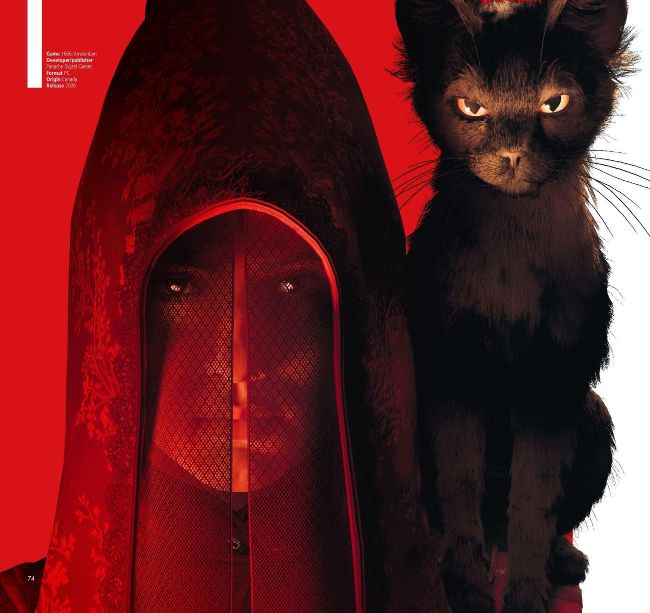
Game 1666: Amsterdam Developer/publisher Panache Digital Games Format PC Origin Canada Release 2026
This cursed game begins in a suitably cursed setting, the action laid out beneath a smoky midnight moon, deep in a forest, the air alive with the ugly buzzing of flies. A woman wanders through the trees, sullen, dressed in red. She has magical abilities, and can draw energy out of the environment and ignite fires with her wooden staff. Up ahead, in the centre of the wood, is a clearing. A single tree rises up, its branches reaching out in all directions. And, sat on every one of those branches, a cat. Figures emerge from the shadows around the tree. The woman is asked to give a little blood. She is here to choose a cat to be her companion. She is Noa Brooklyn, the Collector, and she is here to begin her commencement ceremony as a witch.
This is 1666: Amsterdam, and it did not used to be like this. A leaked trailer from a version that is now over a decade old offers windmills and shipyards and the architecture of empire in place of a forest. A figure in black rides alongside a busy canal, causing mischief and misfortune with spells and incantations. The devil himself has come to town.
WAS DÉSILETS EXPECTING TO EVER GET THE RIGHTS TO 1666: AMSTERDAM BACK? “YES,” HE REPLIES INSTANTLY. “YOU HAVE TO BELIEVE IN IT”
“The origin of the story?” the game’s creator laughs, looking distinctly un-witchlike in a baseball cap and T-shirt, talking to us alongside some of his team via Zoom call. “It all goes back to 2011.” Patrice Désilets, who made his name working at Ubisoft on Prince Of Persia: The Sands Of Time and the very first Assassin’s Creed – he served as creative director on the latter – had, at that time, just left the publisher and was about to join THQ.
“I went to Amsterdam to see the tulips during April,” he recalls. “Suddenly I went, ‘You know what, I could have done an Assassin’s Creed game here’. I could see all the houses and the canals. It’s level design. And, before that, I already had the idea of making a game set in 1666, because of 666, the number of the beast. Then I turned a corner, just in front of the city’s seven bridges. And I turned around, and there was a building on which it’s written: ‘Anno 1666’.”
Clearly guided by providence, this was enough for Désilets. “Here it is. Let’s do a game here in 1666. A game about the devil. I pitched that idea to THQ. So it all started 16 years ago. And it didn’t work out with them.”

Patrice Désilets, cofounder and creative director
That is rather an understatement. In 2011, Désilets began development on the game that would become 1666: Amsterdam, working with a team of 50. THQ filed for bankruptcy in December 2012. THQ Montreal, where Désilets worked, was sold in 2013, and in a mean twist of fate Désilets found out that he was back working for Ubisoft, the new owner. But not for long. He was made redundant in 2013, and it would be another three years until he retrieved the rights to his game concept.
By this point, Désilets was two years into another project, Ancestors: The Humankind Odyssey, the survival game set among hominids in prehistoric Africa. Was he expecting to ever get the rights to 1666: Amsterdam back? “Yes,” he replies instantly. “You have to believe in it. Otherwise, you don’t go through all the process of having all those tough moments, first with your own lawyers, and then you receive the answer back from the other side, and it’s all BS. And then you receive your bills, and then eventually you’re in front of their lawyers… Eventually I receive a phone call from my lawyer saying: ‘Yeah, they want to settle’.”